
The most important thing to understand about the urban bike shift is that it is usually not a conversion to a car-free identity. It is a change in what works best for a certain kind of trip. When the destination is nearby, the decision is less about maximum speed and more about total friction: traffic signals, garage exits, parking, pickup queues, one-way detours, carrying small items, and getting back home again. In dense neighborhoods, bikes increasingly win that door-to-door comparison.
TL;DR
- What looks like a “bike commute” trend is often a short-trip substitution trend: people are choosing bikes for errands, social stops, and station access, not only for the classic home-to-office ride.
- In the 2022 National Household Travel Survey, shopping and personal errands accounted for 35.2% of person trips, compared with 18.4% for trips to and from work. (fhwa.dot.gov)
- Urban residents ages 16 and older were about twice as likely as rural residents to report using a bike in the prior 30 days, 11.6% versus 5.7%. (fhwa.dot.gov)
- As of June 30, 2025, the Bureau of Transportation Statistics counted 72 public docked bikeshare systems with 9,624 docking stations in the U.S., giving many city riders a way to bike without owning a bike. (bts.gov)
- Bikes are most attractive when the trip is short, parking is annoying, cargo is manageable, and the route feels safe enough to repeat regularly.
This is less about replacing every car trip and more about reclaiming the nearby ones
Nationally, biking is still a small share of work commuting. In the 2022 National Household Travel Survey, bicycling accounted for 1.1% of usual commute mode share and 0.7% of actual commute mode share on the travel day. That matters because it keeps the story honest: the bike shift is not a universal replacement for driving. But the same survey also shows why bikes remain relevant in cities. A much larger share of everyday travel is made up of shopping, personal errands, and social or recreational trips than pure commute trips, which is exactly where short urban rides make the most sense. (fhwa.dot.gov)
The urban pattern is distinct. In the 2022 survey, 11.6% of urban residents ages 16 and older reported biking in the previous 30 days, compared with 5.7% of rural residents. The same report says 60% of bicycle users lived in a metropolitan area with at least 1 million residents. That does not prove every city is booming, but it strongly suggests that dense places create the conditions where bikes become practical routine transportation rather than occasional recreation. (fhwa.dot.gov)
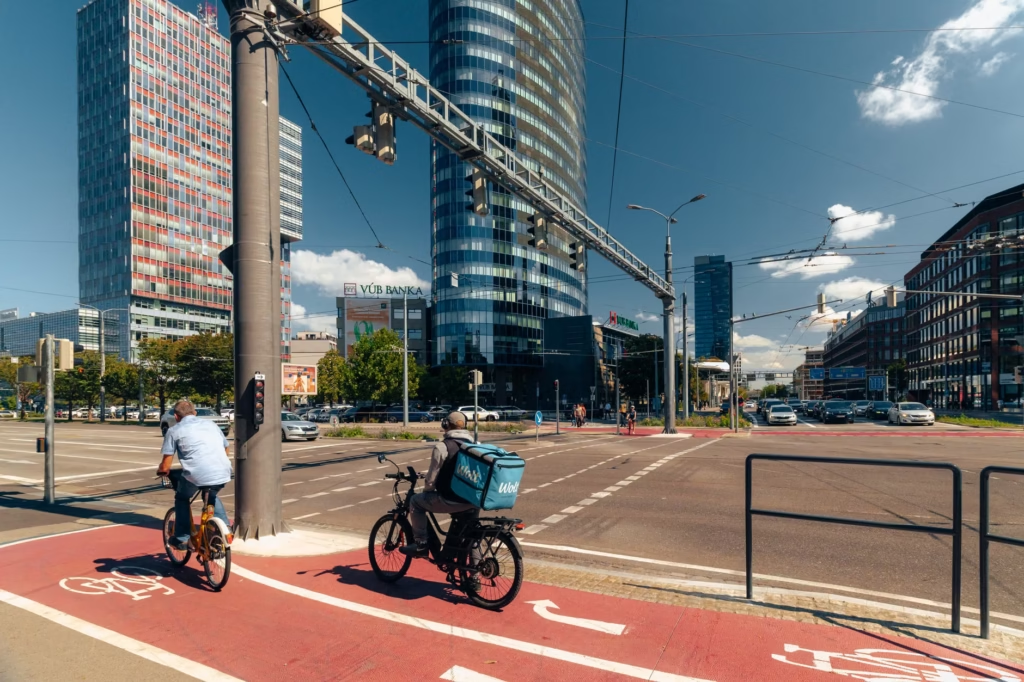
Why short urban trips are increasingly bike-shaped
Cars keep their advantage on longer trips, heavy cargo runs, complex family logistics, and routes with unsafe street conditions. But for short everyday trips, a city changes the math. A rider can often leave from the front door, take a direct route, stop close to the destination, and leave again in seconds. A driver may still travel faster while the car is moving, yet lose the time savings in access and storage. That difference becomes more obvious when one trip turns into three: office, pharmacy, grocery store, then home.
| Decision factor | Bike tends to work well when | Another mode may be better when |
|---|---|---|
| Door-to-door time | The trip is roughly 1 to 4 miles and parking is slow or expensive | The trip is long, highway-oriented, or includes a big elevation challenge without an e-bike |
| Errands and multiple stops | You are making several quick stops with light items | You need to buy bulky groceries or transport large equipment |
| Arrival requirements | Casual clothes are fine, or the route is easy enough to avoid heavy exertion | You need formal clothes, no wrinkle risk, and have no place to freshen up |
| Route comfort | There are protected lanes, calm side streets, or a low-stress route | The route depends on high-speed arterials, hostile intersections, or poor night visibility |
| Cost per trip | You want to avoid fuel, parking, fares, and app-based fees | You already need the car for another essential part of the trip |
| Weather resilience | Conditions are mostly manageable and you have a backup plan | Extreme heat, storms, ice, or strong winds are routine and timing is fixed |
There is also a distance sweet spot behind this. Federal Highway Administration analysis of national travel data has long found that active modes cluster around close destinations: average walk trips were about 0.7 miles and average bike trips about 2.2 miles in the underlying analysis. That does not mean every 2-mile trip should be ridden, but it helps explain why bikes fit so naturally into urban life built around coffee runs, school drop-offs, corner stores, and short commutes to transit or work. (fhwa.dot.gov)
Four forces are making the bike option easier to choose
1. Nearby trips make the car feel inefficient
For short city trips, the problem is rarely the engine. It is the overhead. Starting the car, waiting in traffic, finding parking, and reversing the whole process for a stop that may last five minutes can feel absurd once the destination is genuinely close. The more a person notices that mismatch, the more a bike starts to look like ordinary transportation rather than a lifestyle choice.
2. Access has improved, even for people who do not want to own a bike
A decade ago, many city residents had to buy a bike, store it, maintain it, and commit to riding before they could test whether biking actually fit their routine. That barrier is lower now. The Bureau of Transportation Statistics reported that, as of June 30, 2025, 72 public docked bikeshare systems operated 9,624 docking stations in the United States. BTS also counted 80 dockless bikeshare systems and 197 e-scooter systems serving many cities. Even if a commuter eventually buys a bike or e-bike, that larger micromobility network changes expectations: biking becomes something people can try first and optimize later. (bts.gov)
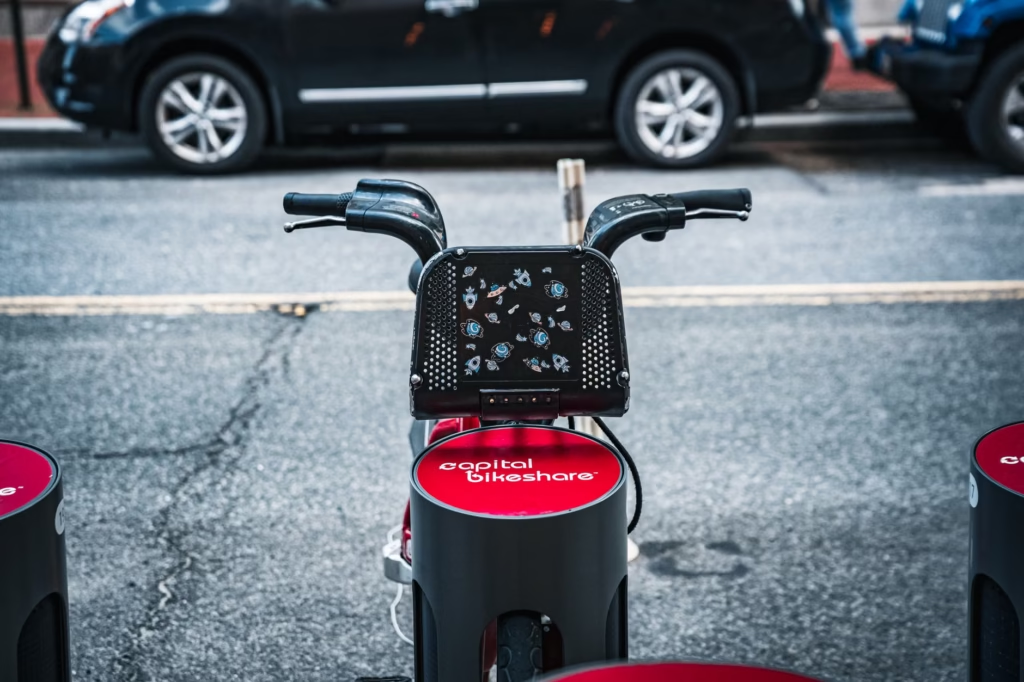
3. Better infrastructure changes the emotional calculation
A short trip is only attractive by bike if it feels repeatable. That is why infrastructure matters so much. The CDC says roadway engineering measures such as bike lanes can improve safety for bicyclists, and the agency also points riders and planners to Federal Highway Administration guidance on proven interventions. FHWA now treats separated bike lanes as a mainstream design topic with dedicated planning and design guidance. In practical terms, that means more commuters can imagine biking in normal clothes at normal speeds, not riding defensively in fast mixed traffic every day. (cdc.gov)
4. The trip can replace a separate exercise block
Health is not always the first reason people switch, but it often helps the habit stick. The CDC says adults who sit less and do any amount of moderate- to vigorous-intensity physical activity gain some health benefits, and regular activity is linked with better cardiovascular health, lower risk of type 2 diabetes, better function, and other long-term benefits. At the same time, the EPA says transportation is the largest source of U.S. greenhouse gas emissions, accounting for about 28% of total emissions. A short bike trip will not solve either problem by itself, but it gives one daily trip more than one job to do. (cdc.gov)
Use the Short-Trip Friction Test before you buy gear or make a big commitment
A simple way to judge whether biking fits an everyday trip is to stop asking, “Could I bike this?” and start asking, “Where is the friction now?” The more friction a car or transit trip has relative to the actual distance traveled, the stronger the case for a bike.
- Map the real door-to-door trip. Include the walk to the garage, the elevator, the station entrance, or the parking search, not just the distance on a navigation app.
- Count stop penalties. Every time a trip requires parking, reloading, paying, or waiting, that penalty matters more on short trips than on long ones.
- Check route stress, not just route length. A calm 2.5-mile ride can feel easier than a hostile 1-mile ride through fast traffic and complex turns.
- Look at arrival conditions. If the destination requires carrying a laptop, changing clothes, or securing the bike outside for hours, build that into the decision.
- Plan for the least ideal day, not the ideal day. Heat, rain, darkness, and a tired evening ride are what determine whether the habit survives.
- Keep a backup mode. The most durable bike commuters usually think in combinations: bike most days, transit in storms, car when the load is unreasonable.
If the route depends on high-speed arterials with weak bike facilities, the problem is not a lack of motivation. It may simply be a bad route for a routine ride. Safety and comfort are legitimate decision factors, not excuses.
A realistic example: why one ordinary errand chain often works better by bike
Consider a hypothetical city resident who works two miles from home, stops at a pharmacy on the way back, and picks up a few groceries most evenings. None of those destinations is far away. By car, each stop comes with a restart cost: pulling out, waiting at lights, circling for parking, carrying bags from the curb, then doing it again. By bike, the moving portion may not be dramatically faster, but the reset cost is lower. Lock, walk in, walk out, unlock, go. Over a week, that is often what converts someone from an occasional rider to a regular short-trip rider.
This is also why many new urban riders do not begin with a five-day office commute. They start with the easiest win: the Saturday coffee run, the weekday grocery stop, the school or daycare connection, or the ride to a transit station. Once that trip feels reliable, other nearby trips start to look bikeable too.
What still keeps many commuters from riding more
The limitations are real, and serious articles should say so clearly. The CDC notes that bicycle trips make up about 1% of all trips in the United States, yet bicyclists account for 2% to 3% of people who die in crashes involving a motor vehicle on U.S. roads. The CDC also says most bicyclist deaths occur in urban areas. So the main barrier is not laziness or lack of awareness. It is often a rational concern about route quality, intersection design, speed, and exposure to drivers. (cdc.gov)
- Secure parking remains a deal-breaker. A trip that is easy to ride can still fail if theft risk is high at home, work, or stores.
- Weather matters less than many non-riders assume, but extreme heat, storms, ice, and darkness absolutely affect repeatability.
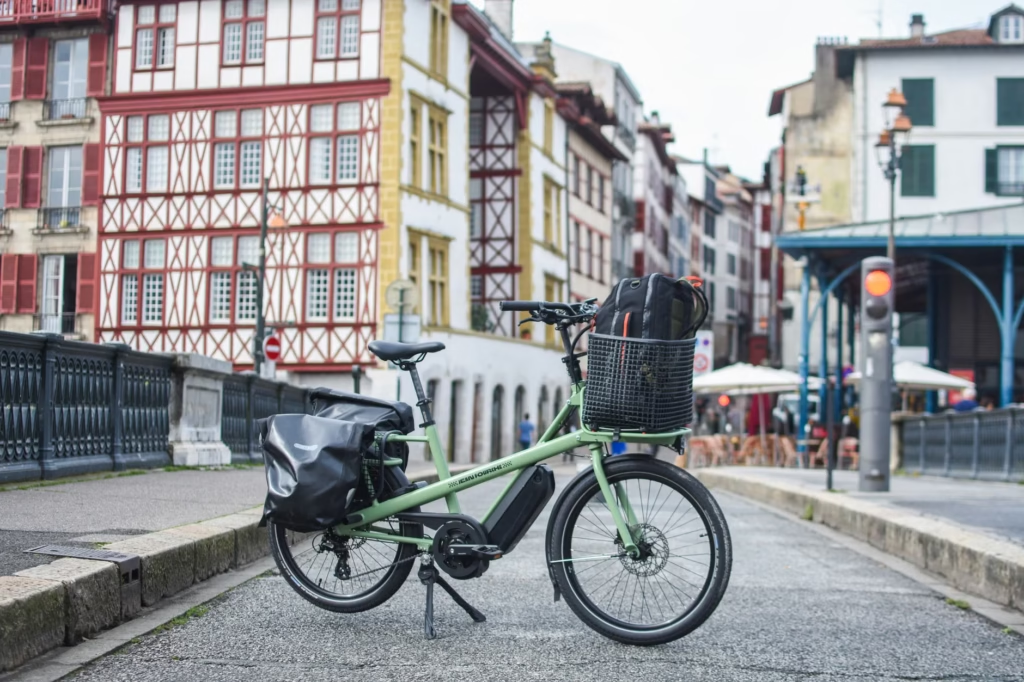
- Cargo is manageable up to a point. Panniers, baskets, and e-bikes solve many small-load problems, not every large-load problem.
- Dress codes and arrival expectations still shape mode choice. A low-exertion route is different from a sweaty one.
- Family logistics can help or hurt the switch. One person’s short solo commute may be easy by bike while the household’s morning chain is not.
How to try the switch without turning it into a project
- Pick one recurring trip, not your whole week. The best test case is short, frequent, and low-stakes.
- Ride the route once at a calm time of day. Look for traffic speed, turning conflicts, pavement quality, and where you would lock up.
- Optimize comfort before performance. Lights, fenders, a rack, panniers, and ordinary clothes usually matter more than a lighter bike.
- Decide whether a standard bike, e-bike, or bikeshare actually fits the job. The right answer depends on hills, cargo, and arrival requirements.
- Set a weather rule in advance. For example: bike unless there is lightning, ice, or extreme heat. Pre-deciding prevents daily debate.
- Review after two weeks. If the trip still feels stressful, change the route, timing, or equipment before deciding that biking simply does not work.
That last step matters. Many failed bike-commuting experiments are really route-design failures, cargo failures, or expectation failures. People often test biking on the hardest possible version of the trip, then conclude the mode itself is the problem. A calmer street, a smaller load, or one borrowed e-bike can change the result completely.
What this shift means for cities
When more short trips move to bikes, the benefit is not only individual convenience. It can also reduce pressure on curb space, parking demand, and overloaded short-hop car travel. That is one reason public agencies increasingly treat biking as part of a broader transportation system rather than a recreation niche. The spread of bikeshare stations, protected-lane guidance, and active transportation planning reflects that change in mindset, even though adoption remains uneven from one city to another. (bts.gov)
The bigger lesson is simple: bikes do not have to beat cars at everything to become a rational urban choice. They only have to beat them often enough on the nearby trips that shape everyday life. For many city commuters, that threshold has already been crossed. The next question is not whether biking is universally better. It is which trips in a real routine are now better by bike than they used to be.
Frequently Asked Questions
Are bikes actually faster than cars for short city trips?
Sometimes, yes, but the better comparison is door-to-door time rather than moving speed. On a short urban trip, parking, curb access, and repeated stops can erase a car’s speed advantage. That is why bikes often win on nearby errands even when they do not win on longer commutes.
Do e-bikes belong in this conversation?
Absolutely. For many commuters, e-bikes remove the barriers that keep a standard bike from working well, especially hills, heat, heavier cargo, and arriving without overexertion. They are often the mode that turns a plausible bike trip into a practical daily one.
Is bikeshare enough, or do most commuters eventually need their own bike?
Bikeshare is often the easiest entry point because it lowers the cost and commitment of trying short trips. BTS reported 72 public docked bikeshare systems and 9,624 docking stations in the U.S. as of June 30, 2025, so access is much broader than it once was. But riders who carry more gear, travel at unusual hours, or want more consistency may eventually prefer owning a bike or e-bike. (bts.gov)
What is the biggest reason some commuters still avoid biking?
Safety and route stress are still the biggest practical constraints. The CDC says most bicyclist deaths occur in urban areas and points to engineering measures such as bike lanes as part of the safety solution. That is why infrastructure quality matters more than generic encouragement. (cdc.gov)
How can someone tell if biking is realistic without buying a lot of gear?
Test one repeat trip first. Use bikeshare if available, ride at an easy time of day, and pay attention to route comfort, parking, cargo, and arrival conditions. If one short trip works consistently, that is a better indicator than any broad claim about whether city commuting by bike is “for you.”
References
- Federal Highway Administration – Summary of Travel Trends: 2022 National Household Travel Survey – https://www.fhwa.dot.gov/policyinformation/2022Summary_of_Travel_Trends_Report.pdf
- Federal Highway Administration – Chapter 3: Travel – https://www.fhwa.dot.gov/policy/23cpr/chap3.cfm
- Bureau of Transportation Statistics – Docked Bikeshare Stations Expanded Although Number of Systems Slightly Falls While – https://www.bts.gov/newsroom/docked-bikeshare-stations-expanded-although-number-systems-slightly-falls-while-number-e
- Centers for Disease Control and Prevention – Bicycle Safety – https://www.cdc.gov/pedestrian-bike-safety/about/bicycle-safety.html
- Centers for Disease Control and Prevention – Benefits of Physical Activity – https://www.cdc.gov/physical-activity-basics/benefits/
- U.S. Environmental Protection Agency – Fast Facts on Transportation Greenhouse Gas Emissions – https://www.epa.gov/greenvehicles/fast-facts-transportation-greenhouse-gas-emissions
- Federal Highway Administration – Separated Bike Lane Planning and Design Guide – https://highways.dot.gov/safety/pedestrian-bicyclist/safety-tools/pg-77-82-separated-bike-lane-planning-and-design-guide
- Centers for Disease Control and Prevention – Active Communities Tool Action Planning Guide – https://www.cdc.gov/active-communities-tool/media/pdfs/2025/05/347625-A_ACT-guideMay-2025_Final_508.pdf