
E-bike commuting matters because it solves a specific transportation problem. It turns trips that are too far, too hilly, too sweaty, or too time-sensitive for many people on a regular bike into realistic daily travel. That matters in a country where commuting is still heavily car-dominated: in 2024, 69.2% of workers drove alone, the mean one-way commute was 27.2 minutes, public transportation accounted for 3.7% of commute trips, and 13.3% of workers worked from home (census.gov).
The policy context is moving in the same direction. The U.S. Department of Transportation says its 2022 – 2026 Strategic Plan calls for a 50% increase in the share of person trips made by transit and active transportation modes from 2020 levels. DOT also describes electric micromobility, including e-bikes, as a way to extend the reach of active transportation, close first- and last-mile gaps, and reduce reliance on cars. That has climate significance too: transportation accounted for 29% of U.S. greenhouse gas emissions in 2022, according to EPA (transportation.gov).
TL;DR
- E-bikes are compelling for commuting because they reduce effort barriers and make longer everyday bike trips more practical. DOT notes that electric micromobility extends active transportation, and more than half of U.S. trips in 2021 were under three miles (transportation.gov).
- The biggest city implications are not just about selling more bikes. They involve safer route design, better bike-to-transit connections, secure parking and storage, and smarter curb management (transportation.gov).
- Safety is the deciding issue. Better separated lanes can reduce crashes on some roads, but design quality, conflict points, battery safety, and product certification all matter (transportation.gov).
- Not every e-bike trip replaces a car trip. DOE data on shared micromobility show a mixed pattern, which means cities should treat e-bikes as part of a broader transportation system, not as a universal substitute for driving or transit (energy.gov).
Why commuting is e-bikes’ breakthrough use case
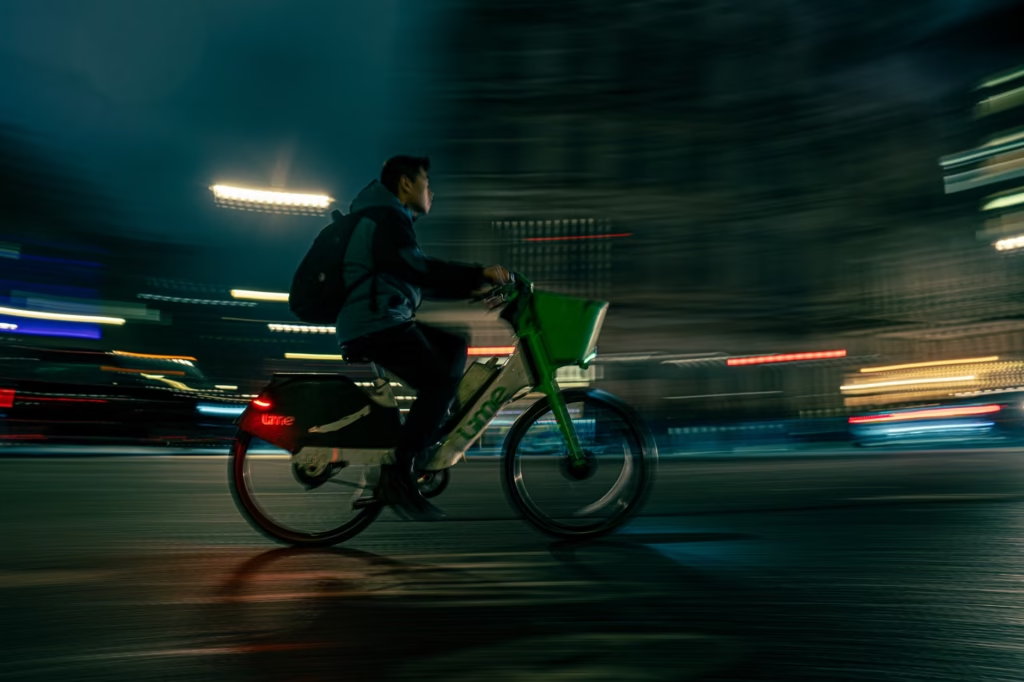
A standard bike asks a lot from a commuter. It asks for time, physical effort, route confidence, weather tolerance, and somewhere secure to leave the bike at the end. An e-bike does not remove those constraints, but it weakens one of the biggest ones: effort. Under the federal consumer definition summarized by CPSC, an e-bike is a bicycle with fully operable pedals and an electric motor under 750 watts, with a maximum motor-only speed under 20 mph. The market also commonly uses class categories that distinguish between pedal-assist and throttle bikes and between 20 mph and 28 mph assist limits (cpsc.gov).
The demand side already looks substantial. DOT’s active transportation guidance cites Bureau of Transportation Statistics data showing that in 2021, 52% of all U.S. trips were under three miles and 28% were under one mile. Meanwhile, shared micromobility is no longer a niche experiment: NABSA says at least 225 million shared micromobility trips were taken in 415 cities across North America in 2024, and NACTO reported that in September 2025, station-based e-bikes in member cities averaged 6.3 trips per bike per day versus 3.4 for pedal bikes. That does not prove every shared trip is a commute, but it does show that when e-bikes are available in real transportation networks, people use them heavily (transportation.gov).
That is why the future transportation question is not simply whether more people will buy e-bikes. It is whether cities can support the kinds of trips e-bikes are unusually good at: short- to mid-length urban trips, first- and last-mile connections to transit, errands with some cargo, and commutes where door-to-door time matters more than peak speed. If those use cases grow, cities will need to rethink infrastructure as a daily utility network rather than a recreational amenity (transportation.gov).
Use the commuter-friction map before calling anything a commuting revolution
The most useful way to judge an e-bike’s city potential is not by top speed or battery size. It is by how much friction it removes from the whole trip. The commuter-friction map below is an editorial decision tool, not a formal planning standard, but it is a practical way to think about whether a corridor is genuinely ready for e-bike commuting.
- Map effort friction. Look for hills, bridges, heat, work clothes, headwinds, and any trip condition that makes a regular bike feel like a workout instead of transportation.
- Map stress friction. Ask whether a cautious adult would ride the route during rush hour. Missing lane segments, fast multilane traffic, and complicated intersections matter more than a bike’s motor.
- Map time friction. Compare true door-to-door time, not just riding time. A bike that is quick on the street but slow to store is less useful than it looks.
- Map end-point friction. Secure parking, storage, elevator access, lockers, and safe charging rules are often more important than raw battery range.
- Map load friction. Laptop bags, groceries, child seats, tools, or delivery loads can be the difference between a fun ride and a viable commute.
A city or route usually has real e-bike commuting potential when the bike removes effort and time friction and the city has also addressed stress and end-point friction. DOT’s active transportation guidance explicitly lists protected lanes, intersection treatments, secure parking and storage, workplace support, transit integration, and traffic calming as the kinds of measures that make active travel workable. DOE’s active transportation guidance likewise points to bike racks, locker rooms, showers, and maintenance facilities as practical employer support. In other words, the e-bike itself is only half the system (transportation.gov).
How rising e-bike use changes the city transportation system
Street design shifts from recreational access to all-day utility
If e-bike commuting grows, cities cannot rely on disconnected painted lanes that work only for the most confident riders. DOT says separated bicycle lanes can reduce crashes by up to 49% on certain four-lane and local roads, and FHWA has highlighted examples where converting traditional lanes to separated lanes with flexible delineators reduced bicycle-vehicle crashes by up to 53%. But design quality matters. IIHS notes that separated lanes are not equally safe in every configuration, and that fewer driveways, fewer intersections, more continuous separation, and less crossing complexity can lower risk. The practical lesson is simple: the future is not just more bike lanes. It is lower-conflict networks (transportation.gov).
Transit works better when e-bikes widen the catchment area
One of the most important transportation effects may be at the edge of transit systems rather than in city cores. DOT describes active transportation as a valuable extension of public transit because it can close first- and last-mile gaps. But cities should not assume every e-bike trip helps transit. DOE’s summary of North American shared micromobility survey data found that 37% of shared micromobility trips replaced a car trip, 13% replaced transit, and about 35% replaced walking. That mixed substitution pattern means e-bikes can either strengthen a transit system or chip away at it, depending on how the network is designed. Secure station parking, visible bike-share docks, easy transfers, and street approaches that feel safe are the moves that push e-bikes toward complementing transit instead of merely competing with it (transportation.gov).
Buildings, parking, and curb management become transportation policy
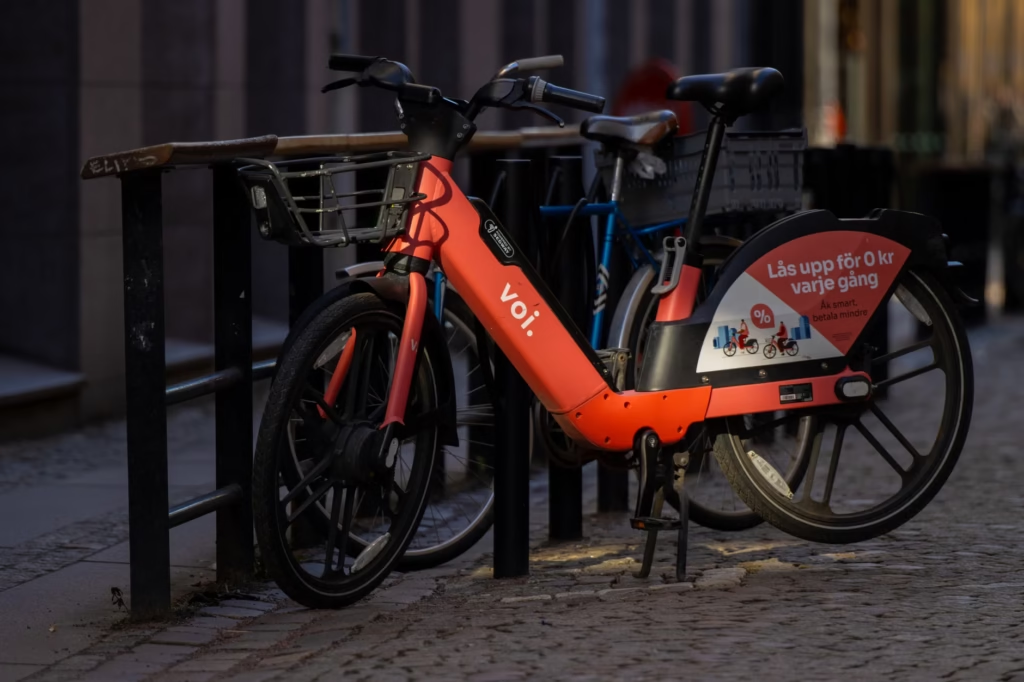
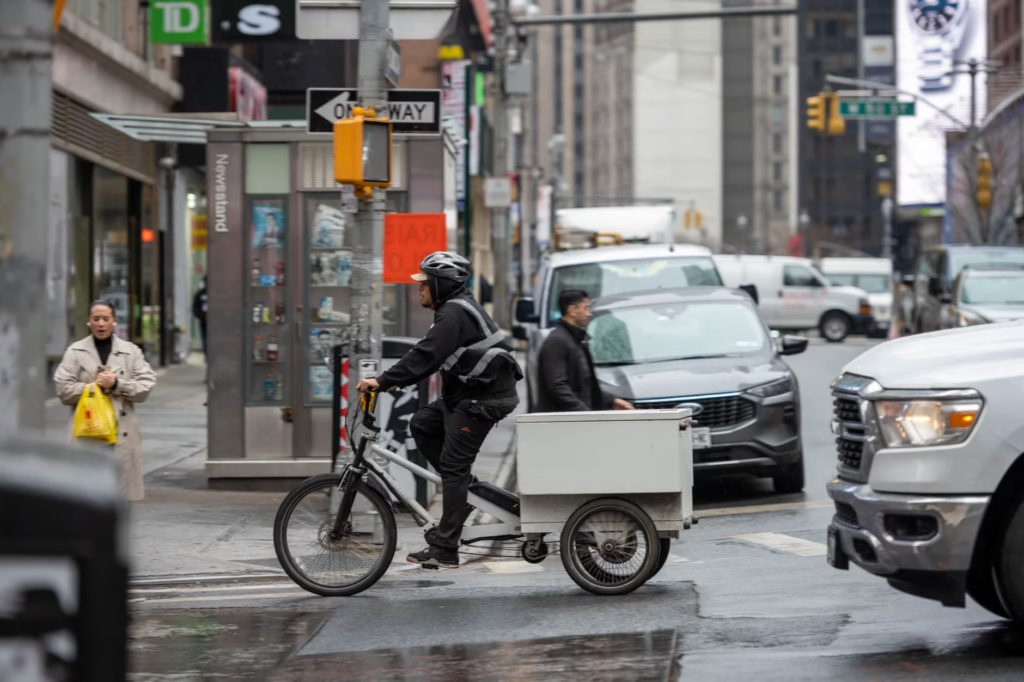
E-bike commuting also moves transportation planning into places cities do not always treat as transportation infrastructure. DOT’s active transportation guidance calls out secure parking and storage, workplace facilities, transit integration, parking pricing, and even micromobility parking standards as part of the toolkit. DOE similarly points to bike racks, locker rooms, showers, and maintenance facilities. The logic is hard to escape: a valuable, heavier bike that cannot be parked safely at home, work, or a station is not a reliable commute tool. On the freight side, DOT also notes that micromobility can support more sustainable urban delivery by helping cargo bikes reduce the need for some delivery truck trips. So the rise of e-bike commuting affects not only bike lanes, but also loading zones, building rules, and curb allocation (transportation.gov).

| System area | Why e-bike growth changes it | Best near-term response |
|---|---|---|
| Protected lanes and intersections | Commuters need direct, low-stress routes, not isolated segments. | Build continuous protected corridors and reduce conflict points at driveways and intersections. |
| Transit stations and stops | E-bikes can extend transit access, but they can also pull trips away from transit if transfers are awkward. | Add secure parking, station-area bike share, and safer approaches to stops and hubs. |
| Residential and office buildings | A ride fails if there is nowhere safe to store or charge the bike. | Require or encourage secure storage, practical access routes, and clear charging rules. |
| Curb space and loading | Bike lanes, delivery activity, and pickup zones compete for the same space. | Create loading zones that do not block bike lanes and plan for cargo-bike staging. |
| Product safety and public trust | Battery fires and low-quality components can undermine adoption. | Push certification, safe charging education, and disposal or recycling guidance. |
The table’s main implication is that e-bike commuting is not a single-mode issue. It touches the street network, the transit network, buildings, the curb, and consumer-product regulation at the same time. That is exactly why it is now a city transportation topic rather than just a bike industry topic (transportation.gov).
Where the optimistic story runs into real constraints
- Safety exposure is rising along with use. CPSC estimates 155,200 e-bike-related emergency department visits and 310 fatalities from 2017 through 2024. But NHTSA also cautions that raw crash totals are an imperfect safety indicator without exposure data, because more riding can raise total crashes even when individual risk is changing differently (cpsc.gov).
- Urban conditions remain the core challenge. NHTSA says 1,103 bicyclists were killed in traffic crashes in 2024 and notes that nearly three quarters of bicyclist deaths occurred in urban areas. That does not mean e-bikes are uniquely unsafe; it means city street safety is still the governing issue (nhtsa.gov).
- Battery quality is not a side issue. CPSC urges consumers to use certified micromobility products, to charge only with the supplied charger, never while sleeping, and to avoid modified or unapproved battery packs. CPSC has also said compliance with relevant UL standards significantly reduces the risk of injuries and deaths from micromobility fires (cpsc.gov).
- The rules are patchy. CPSC’s consumer definition is only part of the story; the market and many states use class-based systems, and NCSL notes that states and localities vary in how and where e-bikes may be operated, including on bicycle paths and greenways (cpsc.gov).
Battery safety is now part of transportation trust. As of June 24, 2026, a federal notice of proposed rulemaking on lithium-ion batteries used in micromobility products had been published, signaling that product safety and city transportation policy are converging more tightly (public-inspection.federalregister.gov).
A common mistake is to treat e-bikes as just faster bikes. In practice, they are also heavier, more expensive, and more dependent on secure storage and trustworthy electrical systems. That changes the planning equation. In many U.S. cities, the more urgent near-term need may not be public curbside charging on every block. It may be safer route design, secure end-of-trip storage, and much clearer rules around indoor charging, certified equipment, and disposal. That is an inference, but it is strongly supported by the kinds of supportive facilities DOT highlights and the battery practices CPSC now emphasizes (transportation.gov).
A realistic example of how the shift happens
Consider a hypothetical commuter who lives six miles from downtown, with one steep climb, one awkward arterial crossing, and expensive parking near the office. On a regular bike, the trip may feel too strenuous for daily use. In a car, the trip may be easy to drive but irritating to park. On an e-bike, the hill largely stops mattering, and the trip becomes especially attractive if the rider has a protected route through the dangerous segment and secure parking at work. But remove either of those conditions and the advantage shrinks fast. That example captures the larger city lesson: most e-bike mode shift comes from improving the whole trip, not from putting a motor on a bicycle and hoping for the best (transportation.gov).
What to watch over the next few years
- More protected networks instead of isolated demonstration lanes.
- More station-area facilities, because bike-to-transit trips are one of the clearest system-wide uses for e-bikes.
- More cargo-bike and micromobility freight planning in dense districts.
- More attention to certification, charging practices, and class-specific regulation as the market matures.
The larger trajectory is already visible. DOT is pushing a mode-shift agenda, shared micromobility is firmly established in hundreds of North American cities, and federal safety attention to micromobility batteries has intensified. That does not guarantee a smooth transition. It does suggest that the transportation question has changed. The debate is no longer whether e-bikes belong in city planning. It is whether cities can adapt street design, station access, building rules, and product safety expectations fast enough to use the mode well (transportation.gov).
For commuters, the practical next step is to evaluate the whole trip with the commuter-friction map, not just the bike’s specs. For city leaders, the priorities are even clearer: connect the network, reduce conflict points, make bike-to-transit transfers easy, provide secure end-of-trip facilities, and treat battery safety as part of transportation policy rather than a separate consumer issue. E-bike commuting will not replace every car trip or every transit trip. It does not need to. If it takes a meaningful share of short and mid-length urban travel, that is enough to reshape how city transportation works (transportation.gov).
FAQ
Are e-bikes mostly replacing car trips?
Not automatically. DOE’s summary of North American shared micromobility data found that 37% of trips replaced a car trip, while 13% replaced transit and about 35% replaced walking. Private ownership patterns may differ, but the basic lesson is that mode shift depends on local design and trip context (energy.gov).
Do cities need public charging everywhere for e-bike commuting to grow?
Probably not as a first move in most places. DOT’s guidance puts strong emphasis on secure parking, storage, transit integration, and workplace support, while CPSC focuses on safe charging practices and approved equipment. For many cities, safe storage and safe charging rules are likely to matter sooner than a dense curbside charging network. That is an inference, but it follows from the current federal guidance (transportation.gov).
Are e-bikes legal anywhere regular bikes are allowed?
No. Federally, CPSC has a consumer-product definition for low-speed electric bicycles, but operating rules are largely set by state and local law. Many states use a three-class system, and localities may apply stricter rules on certain paths, greenways, or facilities (cpsc.gov).
Will more e-bike commuters automatically reduce congestion and emissions?
Only if a meaningful share of trips replaces driving rather than walking or transit, and only if cities build networks that people will actually use. Transportation remains a major source of U.S. emissions, and EPA lists biking and pedestrian programs among the ways to reduce travel demand. But the size of the benefit depends on what trips are displaced (epa.gov).
References
- U.S. Census Bureau – United States Commuting At A Glance: American Community Survey 1-Year Estimates – https://www.census.gov/topics/employment/commuting/guidance/acs-1yr.html
- U.S. Department of Transportation – Improving Safety for Walking, Biking, and Rolling – https://www.transportation.gov/pedestrian-bicycle-safety
- U.S. Department of Transportation – Active Transportation (guidance PDF) – https://www.transportation.gov/sites/dot.gov/files/2024-08/Active%20Transportation%20%28Document%20%28A4%29%29_0.pdf
- U.S. Department of Energy – Alternative Fuels Data Center: Active Transportation and Micromobility – https://afdc.energy.gov/conserve/active-transportation
- U.S. Department of Energy – FOTW #1370: In North America, 37% of Shared Micromobility Trips Replaced a Car Trip – https://www.energy.gov/cmei/vehicles/articles/fotw-1370-november-25-2024-north-america-37-shared-micromobility-trips
- North American Bikeshare & Scootershare Association – About the Shared Micromobility Industry – https://nabsa.net/about/industry/
- NACTO – Shared Micromobility in NACTO Member Agencies: 2025 Trends – https://nacto.org/publication/shared-micromobility-in-nacto-member-agencies-2025-trends/
- U.S. Environmental Protection Agency – Transportation Sector Emissions – https://www.epa.gov/ghgemissions/transportation-sector-emissions
- U.S. Department of Transportation – Safer Roads – https://www.transportation.gov/safe-system-approach/safer-roads
- Insurance Institute for Highway Safety – Pedestrians and bicyclists – https://www.iihs.org/research-areas/pedestrians-and-bicyclists
- National Highway Traffic Safety Administration – Bicycle Safety – https://www.nhtsa.gov/road-safety/bicycle-safety
- U.S. Consumer Product Safety Commission – Micromobility Products-Related Deaths, Injuries and Hazard Patterns 2017-2024 – https://www.cpsc.gov/s3fs-public/Micromobility_Products-Related_Deaths_Injuries_and_Hazard_Patterns_2017-2024.pdf