
An e-bike is not just a bicycle with a motor. For commuting, it is a trade: less effort and often less car dependence in exchange for new questions about route safety, parking, charging, weather, theft, and what happens when the trip goes wrong. That is why the right question is not “Which e-bike should I buy?” It is “Will an e-bike remove more daily friction than it creates?” If the answer is yes, an e-bike can turn a draining commute into something faster, cheaper, and more repeatable. If the answer is no, it can become an expensive object that gets ridden twice a month.
TL;DR
- An e-bike usually makes the most sense when the commute is frequent, the route is reasonably safe, and secure storage exists at both ends.
- The biggest decision factors are not battery size or top speed. They are route quality, cargo needs, sweat tolerance, parking, charging, and bad-weather backup.
- Use the Commute Friction Check below: if most categories are strong yes signals and none are deal-breakers, an e-bike is probably a good fit.
- Do not ignore battery and charging safety. CPSC says to follow the manufacturer’s charging instructions, stay present while charging, and use only approved chargers and replacement batteries. (cpsc.gov)
- Test the commute before buying if possible. A borrowed, rented, or shared e-bike can reveal more in a week than product research can in a month. DOE notes that shared micromobility can help close first-and-last-mile gaps. (afdc.energy.gov)
Start with the commute, not the machine
Many people start by shopping for motors, range, and frame style. That is backward. A commuter e-bike succeeds or fails based on the trip it has to repeat five days a week. In the United States, the mean one-way commute time was 27.2 minutes in 2024, and 69.2% of workers still drove alone. Those numbers help explain why alternatives keep attracting attention, but they do not tell any one person whether an e-bike is practical. The real question is whether the route, routine, and destination make daily riding realistic. (census.gov)
For some commuters, the answer is obvious. A six-mile trip through connected bike lanes, with secure parking at work, is a completely different problem from a 14-mile trip that includes a high-speed arterial, two dangerous intersections, a dress code, and no place to lock up. The same e-bike can feel liberating in the first case and impractical in the second.
Use the Commute Friction Check before you spend money
A useful way to decide is to score the commute, not the product. The Commute Friction Check is a simple editorial scorecard: for each category below, ask whether an e-bike removes a problem, merely shifts it, or introduces a new one. If five or more categories land in the strong yes column and none fall into strong no, an e-bike is probably worth serious consideration. If two or more land in strong no, solve those failures first or rethink the plan.
| Decision factor | Strong yes signal | Yellow flag | Strong no signal |
|---|---|---|---|
| Route safety | Mostly connected low-stress streets, bike lanes, or calm neighborhood roads | Some stressful segments, but reasonable alternatives exist | High-speed roads, repeated dangerous merges, or no realistic bike route |
| Trip length and time | Distance feels too long on a regular bike but realistic on an e-bike | Doable, but only with good weather or partial transit support | Very long trip with no charging, no transit backup, and little schedule flexibility |
| Cargo and clothing | Laptop, lunch, or change of clothes fit easily in panniers or a backpack | Occasional bulky items or moderate dress-code friction | Regular child hauling, heavy tools, or fragile cargo beyond what a normal commuter setup handles well |
| Storage and charging | Secure parking at home and work; safe charging plan exists | Parking is acceptable but exposed, awkward, or shared | No secure storage, building restrictions, or no safe charging option |
| Weather and backup options | Transit, car, or remote-work fallback exists for storms or extreme heat | Backup exists but is costly or inconvenient | No fallback at all, and the route becomes unsafe or miserable in common weather |
| Frequency of use | Commute happens often enough to justify the purchase | Hybrid schedule or an irregular commute reduces value | Rare office days make the bike mostly a hobby purchase |
| Budget fit | Purchase, accessories, maintenance, and theft protection fit comfortably | Budget works only if nothing unexpected happens | Upfront cost strains finances or depends on cutting essential expenses |
This scorecard deliberately avoids vanity specs. A bigger battery does not fix a terrible route. A faster motor does not create secure parking. And a cheap online deal does not stay cheap if the real bottleneck is an apartment stairwell, an office that bans indoor storage, or a commute that requires carrying two overflowing grocery bags in your hands.
Route safety matters more than speed
For commuting, the route is the main variable. NHTSA notes that when a crash occurs between a vehicle and a bike, the cyclist is the one most likely to be injured. CPSC also advises riders to follow local traffic laws, wear a bicycle helmet, and expect that drivers and pedestrians may not see them. In other words, the smartest commuter upgrade is often a safer route, not a more powerful bike. (nhtsa.gov)
A common mistake is assuming an e-bike solves an unpleasant commute because it makes the bike faster. Sometimes the opposite is true. More speed can make poor infrastructure feel worse, especially on narrow lanes, at driveways, or at intersections where turning drivers do not expect a fast-approaching rider. If the daily trip includes repeated points where a rider thinks, “I would hate doing this in traffic every morning,” that is not a small objection. It is the decision.
CPSC’s 2024 special study on e-bike injuries offers a useful, limited signal here. Based on 88 investigated cases, an estimated 24% of the injuries involved motor vehicle accidents, 25% occurred on uphill or downhill surfaces, and 38% involved riders carrying or holding something. That does not prove causation for every commute, but it does show why route conflict points, hills, and cargo handling should be evaluated before buying. (cpsc.gov)
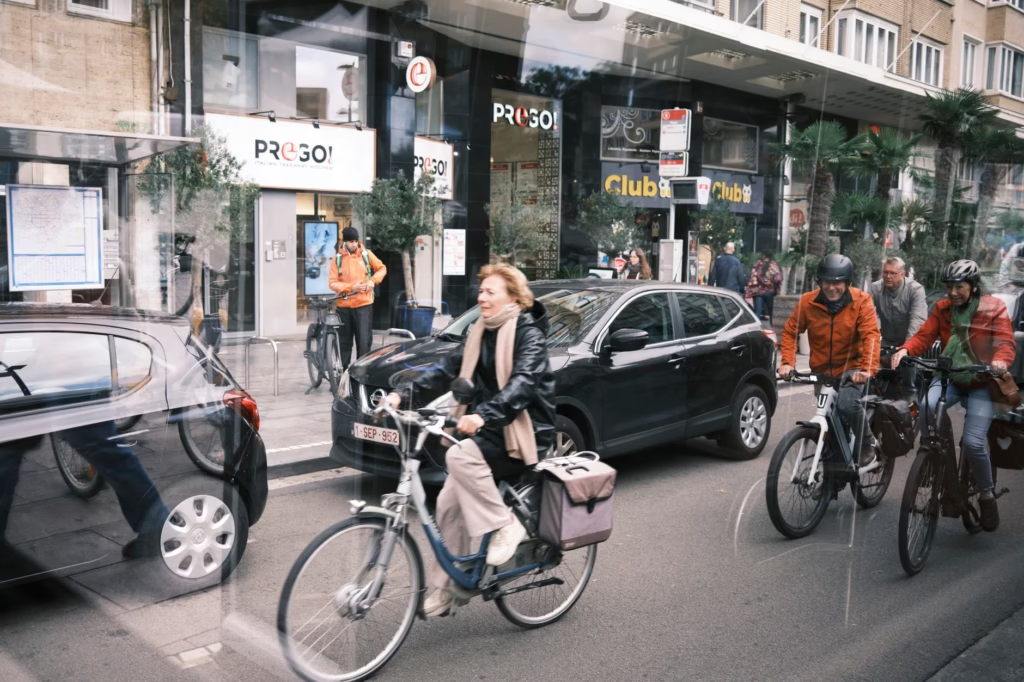
If the route feels unsafe on a normal bike, do not assume a stronger motor is the fix. Try to change the route, split the trip with transit, or reconsider the mode entirely.
Distance, hills, and sweat are where an e-bike can genuinely outperform a regular bike
The strongest case for an e-bike is not usually a tiny trip that is already easy on a standard bike. It is the commute that is just far enough, hilly enough, windy enough, or time-sensitive enough to discourage consistent riding without assistance. An e-bike can flatten hills, reduce arrival sweat, and make a longer ride feel predictable instead of heroic. That matters for work travel because reliability counts more than weekend fun.
The energy economics are favorable. DOE’s Alternative Fuels Data Center says e-bikes can be a low-cost alternative to car use and that charging costs can be less than $50 per year, even for daily riding. That does not include repairs, accessories, or theft protection, but it is a reminder that the electricity itself is usually the least important line item. (afdc.energy.gov)
There is also a health angle, though it should be framed honestly. CDC says casual-pace biking counts as moderate-intensity physical activity. An e-bike commute will not demand the same effort as an unassisted ride, and heavy reliance on the highest assist level will lower exertion, but it can still be meaningfully more active than sitting in a car. That is an inference, not a guarantee, and it depends on speed, terrain, fitness, and how the bike is actually ridden. (cdc.gov)

A realistic example
Consider a hypothetical commuter with an eight-mile trip each way, one notable hill, a laptop, and limited tolerance for arriving sweaty. On a regular bike, the trip may feel possible but too taxing to repeat four or five times a week. On an e-bike with a rear rack and panniers, the same trip may become consistent, faster door to door than driving in traffic, and easier to combine with errands. Now change one detail: no secure parking at work. The commute suddenly stops making sense, even though the ride itself still does.
Storage, charging, and theft are not side issues
A commuting e-bike lives in the real world, not on a spec sheet. That means it has to be parked somewhere, secured somewhere, and charged somewhere. If home storage requires hauling a heavy bike up a narrow staircase every night, or work parking means leaving it on a public rack all day in a high-theft area, those frictions may matter more than range or motor type.
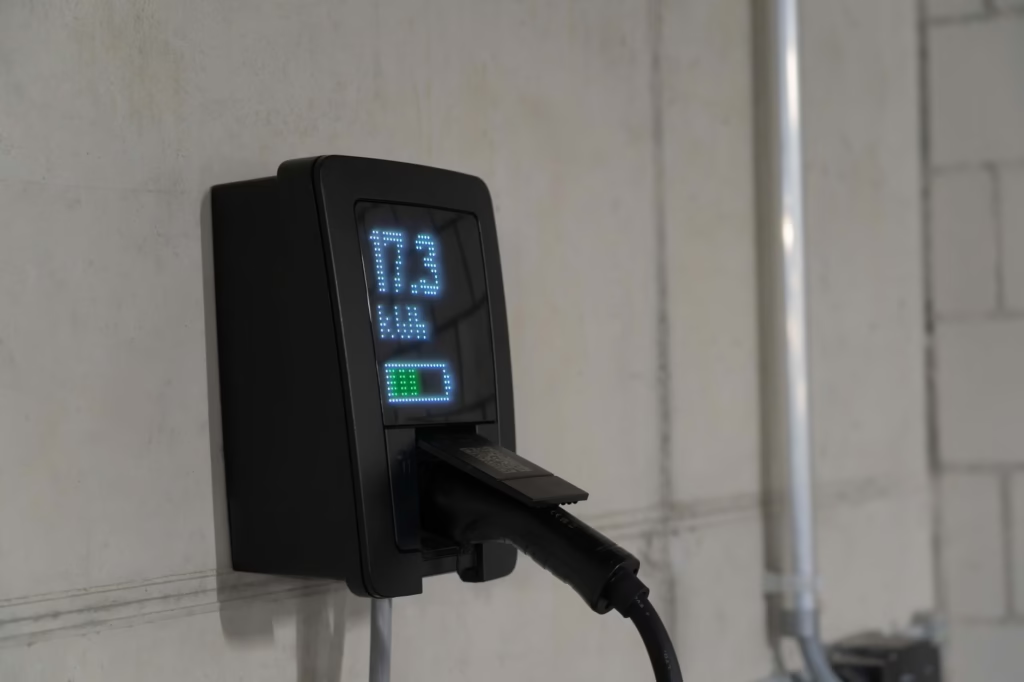
Battery safety deserves more attention than many buyers give it. CPSC says riders should follow the manufacturer’s charging instructions, stay present while charging, never charge while sleeping or away from home, use only the charger provided with or recommended by the manufacturer, and use only approved replacement batteries. CPSC has also said compliance with applicable UL safety standards, including ANSI/CAN/UL 2849 for e-bikes, significantly reduces the risk of injuries and deaths from micromobility device fires. (cpsc.gov)
That makes pre-purchase safety screening part of the commute decision, not an afterthought. UL Solutions notes that a device with a UL-certified battery, motor, or charger is not the same as a UL-certified micromobility device. It also says buyers can verify certification status through the UL Product iQ database using the product’s mark information. For a daily commuter that may charge inside a home or apartment, full-system certification is a meaningful filter. (ul.com)
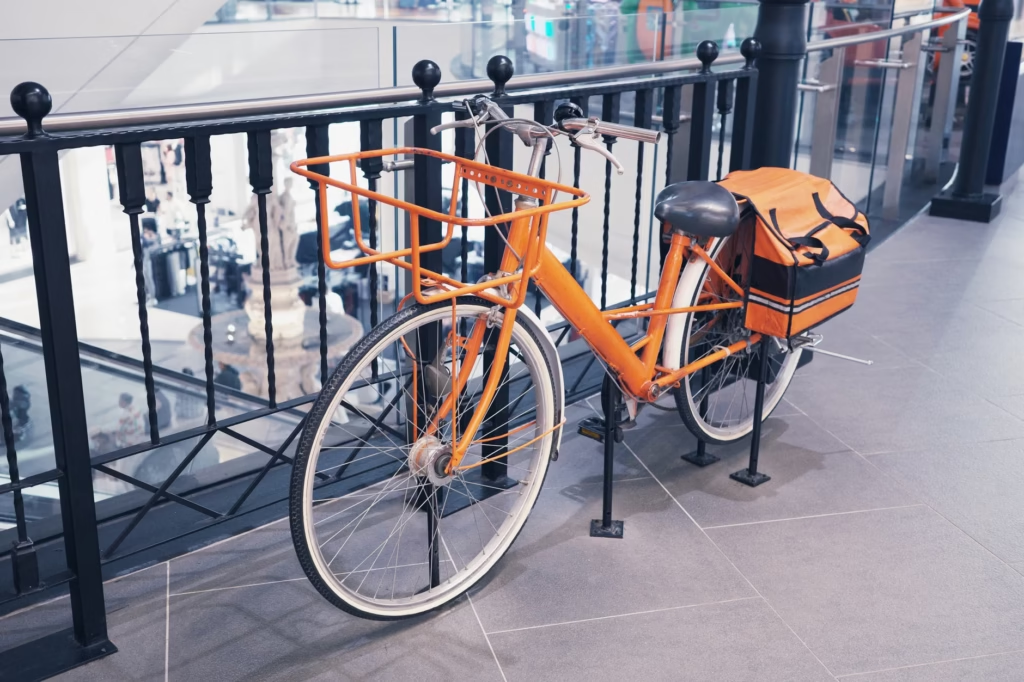
- Confirm where the bike will sleep at home and where it will stay during the workday.
- Check whether the workplace allows indoor storage or charging before assuming it does.
- Look for full-system safety certification, not just a battery claim. (ul.com)
- Avoid aftermarket battery experiments, universal chargers, and bargain replacement packs unless the manufacturer specifically approves them. (cpsc.gov)
Do the math honestly, but do not reduce the decision to gas savings alone
Some commuters buy an e-bike for pure transportation economics. Others value time, flexibility, or the chance to avoid parking headaches. Both are valid. The mistake is pretending the purchase pays off automatically. A commute that happens once a week, with free workplace parking and a difficult riding route, may never justify a dedicated e-bike as a transportation purchase. A commute that happens four days a week, costs money to park, and includes frequent short errands can look very different.
When estimating value, count the whole setup: the bike, lock, lights, helmet, rain gear, rack or panniers, maintenance, and theft protection. Then compare that total with what the bike might realistically replace, such as fuel, parking, ride-hail, transit fares, or a second household car trip. DOE’s note that charging can cost less than $50 a year is useful, but electricity savings alone are rarely the whole story. (afdc.energy.gov)
Why some e-bike commutes fail after the honeymoon period
Most disappointing e-bike purchases follow a pattern. The buyer overestimates motivation and underestimates routine. They imagine pleasant rides, not awkward office clothes, forgotten chargers, wet Tuesday mornings, or the hassle of securing a heavy bike with a full grocery load. None of those problems are dramatic, but together they determine whether the bike becomes part of daily life.
- Buying for maximum speed instead of actual route comfort.
- Ignoring where the bike will be parked for eight or nine hours at work.
- Assuming claimed range matters more than daily charging convenience.
- Forgetting that cargo changes handling; holding bags by hand is a bad plan. CPSC’s 2024 e-bike injury study found many injured riders were carrying something. (cpsc.gov)
- Treating battery safety as optional because the bike was inexpensive online.
- Skipping a real test ride in work clothes, with work gear, on the actual route.
A practical two-week process before buying
- Map the real commute, including the safest version of the route rather than only the shortest.
- Ride or scout the route at commute time. Notice intersections, sightlines, road surface, hills, and where traffic feels unpredictable.
- Measure what you actually carry for work and errands. Plan bags and racks around that load, not around wishful minimalism.
- Verify storage and charging at both ends. If either one is weak, solve that before comparing bike models.
- Borrow, rent, or use a shared e-bike for several trips if possible. DOE notes that shared micromobility can bridge first-and-last-mile needs, and it can also function as a low-risk test before buying. (afdc.energy.gov)
- Reassess after one inconvenient day, not just one pleasant day. If the trip still feels manageable in heat, wind, light rain, or a rushed schedule, that is a much better sign than a perfect Saturday demo ride.
When an e-bike probably does make sense
- The commute is frequent enough to justify daily-use gear.
- A low-stress route exists, even if it is not the shortest route.
- The trip is slightly too long or too hilly to be pleasant on a regular bike every day.
- Secure parking exists at home and work.
- The rider wants a realistic alternative to some car trips, not a total lifestyle reinvention.
- A backup plan exists for storms, illness, or occasional no-ride days.
When it probably does not
- The route is routinely unsafe and there is no better alternative.
- Workplace storage is insecure or prohibited.
- The commute happens too rarely to justify the cost as transportation.
- The rider must regularly haul people or heavy equipment beyond a standard commuter setup.
- Charging and battery storage would be awkward enough to create ongoing safety or convenience concerns. (cpsc.gov)
An e-bike makes sense for a commute when it solves a repeatable transportation problem better than the available alternatives. That usually means the route is safe enough, the distance is useful for pedal assist, the parking situation is secure, and the bike will be ridden often enough to matter. If those basics are not in place, buying a better e-bike is unlikely to fix the underlying issue. Start by stress-testing the commute itself. If the commute passes, the bike choice gets much easier.
FAQ
Do I need the fastest legal e-bike for commuting?
Usually not. Commute quality depends more on route design, intersections, parking, and confidence than on top speed. Also, local rules on where different e-bikes can be ridden vary by community, and CPSC advises checking local traffic laws before riding. Under federal consumer product law, a low-speed electric bicycle is defined as having fully operable pedals, a motor of less than 750 watts, and a top motor-only speed under 20 mph, but that definition does not settle local access rules. (law.cornell.edu)
Can I charge an e-bike battery at work?
Only if your workplace allows it and the setup is genuinely safe. CPSC says to follow the manufacturer’s charging instructions, stay present while charging, and use only the charger provided with or recommended by the manufacturer. If work charging requires shortcuts, improvised outlets, or leaving a battery unattended all day, it may not be a good routine. (cpsc.gov)
Is an e-bike still good exercise?
It can be, but the answer depends on assist level and how it is ridden. CDC says casual-pace biking is moderate-intensity physical activity. An e-bike usually lowers effort compared with a regular bike, but it may still add useful movement compared with driving, especially if it gets ridden consistently. That is an inference, not a universal result. (cdc.gov)
What if my commute includes a train or bus?
That can strengthen the case for an e-bike rather than weaken it. A bike can solve the first-and-last-mile problem even when it does not cover the entire trip. DOE notes that shared micromobility can help close those gaps, which is also a clue that a mixed-mode commute may work well. (afdc.energy.gov)
Is apartment living a deal-breaker?
Not automatically, but it raises the bar for storage and charging. A daily commuter needs a place to park, secure, and charge safely. CPSC warns against charging while sleeping or away from home and recommends only approved chargers and replacement batteries. If the apartment setup makes those basics awkward, the practical answer may be no unless the building has a better solution. (cpsc.gov)
References
- U.S. Census Bureau – United States Commuting At A Glance: American Community Survey 1-Year Estimates – https://www.census.gov/topics/employment/commuting/guidance/acs-1yr.html
- U.S. Department of Energy Alternative Fuels Data Center – Active Transportation and Micromobility – https://afdc.energy.gov/conserve/active-transportation
- U.S. Consumer Product Safety Commission – Micromobility: E-Bikes, E-Scooters and Hoverboards – https://www.cpsc.gov/Safety-Education/Safety-Education-Centers/Micromobility-Information-Center
- U.S. Consumer Product Safety Commission – CPSC Calls on Manufacturers to Comply with Safety Standards for Battery-Powered Products to Reduce the Risk of Injury and Death – https://www.cpsc.gov/Newsroom/News-Releases/2023/CPSC-Calls-on-Manufacturers-to-Comply-with-Safety-Standards-for-Battery-Powered-Products-to-Reduce-the-Risk-of-Injury-and-Death
- U.S. Consumer Product Safety Commission – Micromobility Products-Related Deaths, Injuries and Hazard Patterns 2017-2024 – https://www.cpsc.gov/s3fs-public/Micromobility_Products-Related_Deaths_Injuries_and_Hazard_Patterns_2017-2024.pdf
- National Highway Traffic Safety Administration – Bicycle Safety – https://www.nhtsa.gov/road-safety/bicycle-safety
- CDC – Physical Activity and Your Weight and Health – https://www.cdc.gov/healthy-weight-growth/physical-activity/index.html
- Legal Information Institute – 15 U.S. Code § 2085 Low-Speed Electric Bicycles – https://www.law.cornell.edu/uscode/text/15/2085
- UL Solutions – Is There an E-Bike in Your Future? – https://www.ul.com/there-e-bike-your-future