

Replace your bike helmet after an impact, even if it looks fine. If it’s just really old, you need to evaluate other things as well: the history, condition, fit, and when the manufacturer says to replace it. All bike helmets don’t have an expiration date.[1][2][3][4]
The impact matters more than the scratch
When a bike helmet takes an impact, the protective foam liner compresses. After the foam compresses, it can’t go back to its original shape and isn’t usable anymore. So just because the outside of the helmet looks good, it doesn’t mean it is. Remember, the foam is covered by the hard outer shell, so there’s no way to tell just by looking at it.[1][4][5]
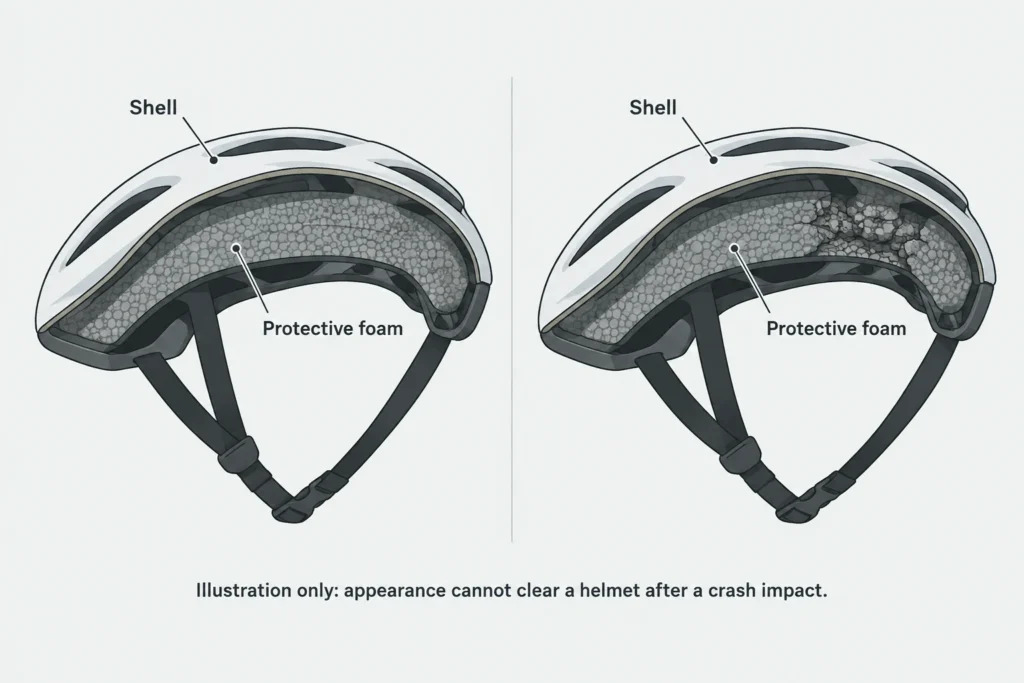
I like to imagine I’m holding my bike helmet the morning after it took an impact, and I’m checking it out under the kitchen light. It looks almost perfect, and buying a new one means I’d have to reorganize my work bag and budget. I really want to settle the question, but I can’t because I know it took an impact. The history comes before the look of the helmet.
You also need to be able to differentiate between when a helmet takes an impact and when it just falls. Sometimes a helmet will take an impact and you’ll never know, but if there’s any doubt about whether the helmet took an impact, I’d replace it. Giro also offers crash replacement, which is worth contacting before you buy a new one.[2][4]
An empty helmet dropped on the floor is a different incident
Dropping a helmet unexplainably happens. A helmet can also be dropped after impact with a surface. How the helmet is dropped is important when considering if there is damage. POC says any impact or suspected damage to the helmet is cause for replacement. Don’t assume rules about helmet replacement for other brands or helmet types apply to POC helmets.[3][4]
Sources didn’t mention a universal drop height. Consult your helmet manufacturer about your model, the surface it was dropped on, and if it was empty when dropped. I would set it aside until that question is answered. If there is damage, it would be an obvious reason to replace it; not finding damage doesn’t mean impact protection is still intact.[3][4][5]
For an older helmet, read the interval carefully
Giro recommends replacement every three to five years; POC specifies three to five years of normal use. Those are manufacturer recommendations, not evidence that every helmet fails on its fifth birthday. The wording matters: does your model count from manufacture, purchase, or first use? If it doesn’t say, ask the manufacturer which date applies rather than guessing.[2][3]
Without manufacturer guidance, the US Consumer Product Safety Commission says replacement within five to ten years of purchase may be prudent, depending on use, care, and storage. That isn’t a ten-year safety guarantee. A closet doesn’t erase an earlier crash or damaging heat exposure. If you can’t establish the helmet’s impact or storage history, I’d replace it rather than rely on its appearance, not because missing history proves damage, but because inspection can’t fill that gap.[1][3]
There’s useful evidence against treating age as automatic foam failure: a 2017 laboratory study tested 770 helmets aged zero to 26 years and found minimal age effects on measured linear impact performance. However, helmets with impact damage were excluded from the study and other features of aging were not evaluated. Thus, the research doesn’t prove your buckles, straps or stored helmet are in good condition, and it does not go against the manufacturer’s advice for a given model.[6]
Look for faults, then check whether it stays put
Inspect the shell and protective foam for deformation and cracking. Check the straps for fraying and stitching for separation. If a buckle has a click, it doesn’t necessarily mean the buckle is fine and will hold. Stop using a helmet with damaged or malfunctioning retention components. Replacement parts are only allowed where the manufacturer approves them.[1][3][5]
Your helmet should rest level to your head and cover your entire forehead, and not be able to roll or shift from it’s position. I would try adjusting the pads or replacing the pads, if approved, on a helmet that has a good, uncrashed, shell before getting rid of it. However, if you still can’t get a secure fit from approved adjustments or replacement pads, then you should get rid of it. The purpose of a helmet is to protect your head, and if you have to continually nudge it back into position, it’s not doing it’s job.[1][3][5]
Sources and references
- US Consumer Product Safety Commission: Which Helmet for Which Activity? (2022-05)
- Giro Sport Design: FAQs, Helmet replacement and crash replacement
- POC: Care Instructions Helmets
- Bicycle Helmet Safety Institute: When Should I Replace My Bicycle Helmet? (2026-08-11)
- Bicycle Helmet Safety Institute: Bicycle Helmet Inspection (2026-08-15)
- Annals of Biomedical Engineering; DeMarco and colleagues: Age has a Minimal Effect on the Impact Performance of Field-Used Bicycle Helmets (2017-05-01)