

Change your commute to accommodate your work clothes rather than the other way around. If work isn’t changeable, your ride clothes will need to work at the start of your shift. A spare change of clothes can’t replace lack of changing access. If a small change is possible, make the small change necessary. The commute should be completed in work clothes unless the job leaves you too soaked or too hot to work.
I’d aim for ready to work at your required start time, not zero perspiration. Those are different goals. A little sweat may be manageable in one workplace; a damp shirt before a client meeting may not be. You don’t need a more elaborate cycling routine than your actual job demands.
What’s actually missing at work?
No shower, no private changing space, and no time to change are three separate problems. Without a shower, you might still be able to replace a damp shirt. Without changing access, you can’t. And an available room doesn’t help if your shift starts the moment you arrive. Don’t count a restroom stall as an option unless it’s permitted, available, and usable for you.
Picture me, in an imagined Monday morning, arriving with a carefully folded shirt and discovering that the only restroom is occupied while my shift is about to start. I’m irritated: I’ve carried the solution without having anywhere to use it. The useful change isn’t another shirt. It’s arranging genuine changing access or choosing an inbound journey I can complete in work clothes.
Ask detailed questions about your job: Are you allowed to wear any shoes? Do you need to keep your uniform at the workplace? Can you take off your outerwear before starting your shift? These are not trivial details. For example, the general surgery residency policy at UCLA Health prohibits its residents from wearing their scrubs outside the facilities. This is an example of a program-specific policy, but it shows that the suggestion of “just riding in your uniform” could be wrong.[1]
Choose the smallest clothing routine that works
| Routine | What it needs at work | What it solves, and leaves you carrying |
|---|---|---|
| Ride in work clothes | No changing space; an outfit acceptable on arrival | Least packing and extra laundry. The outfit still has to work for the ride home. |
| Swap one garment | Permission, privacy where needed, and enough time | Useful when only a shirt or socks fail. You still need somewhere for the damp item and return-trip clothing. |
| Carry a full outfit | Usable changing space and time; room for both outfits | Separates riding clothes from work clothes. Adds bulk, laundry, and possibly duplicate shoes; it doesn’t replace a shower or provide drying. |
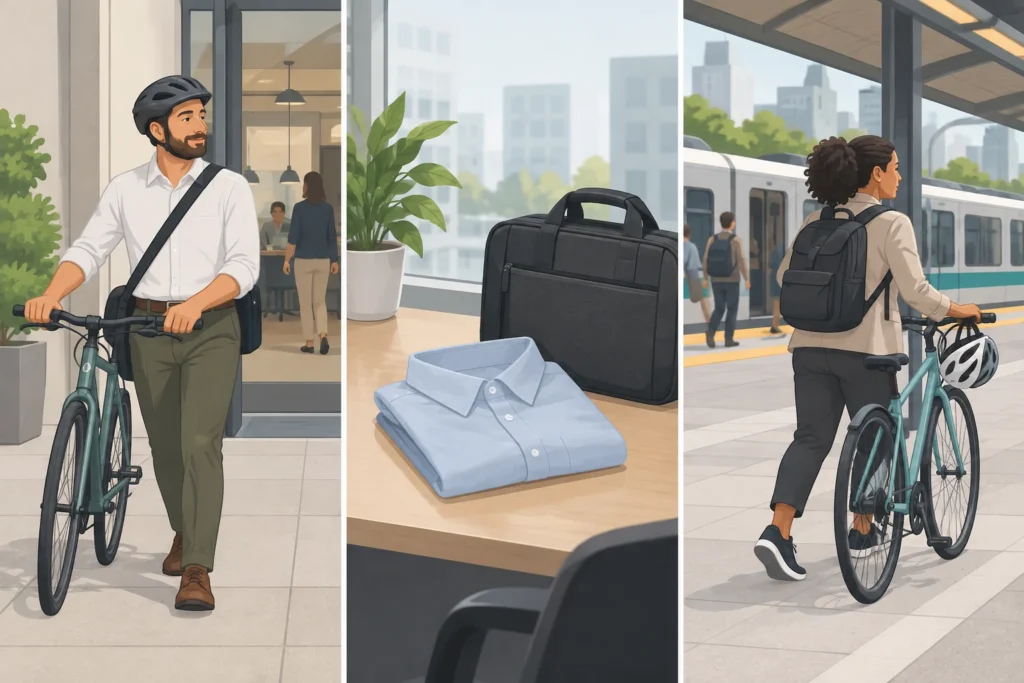
I suggest trying clothes you already have as opposed to buying a commuter wardrobe. See if the outfit you want to wear gives you the clearance you need to pedal and get on and off the bike. If the chain is an issue, fenders will solve the problem a dry shirt will not. A backpack that soaks your shirt could be tested by carrying the load on your bike before buying all new bike-commuting clothes.
A full change of clothes is warranted if several of your clothes are unrideable and you have a place to change. Otherwise, wearing a clean change of clothes all day will not be practical. A quick wash or wipe down can be part of your routine if facilities allow it. However, the clothes you are wearing are still not completely dry.
A drawer isn’t a drying space
Storage solutions for work clothes solve a few different problems. A drawer might hold a clean shirt, but where do you put the damp one? A closed bag might separate damp belongings from the clean ones during transport, but it’s not a drying solution. If you can’t keep anything at work, think about the full daily load, not just the bundle you bring.
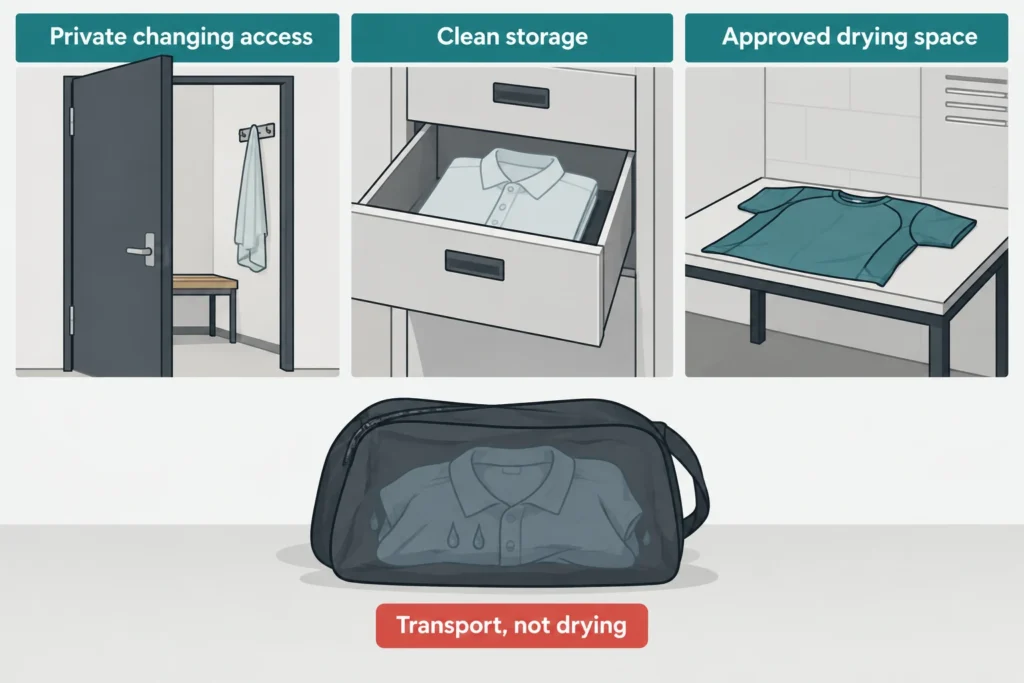
Garment care can help rule out an otherwise convenient setup. Smartwool recommends flat drying and also checking the care label for the individual product. That’s the manufacturer’s care advice, not whether the garment will keep you dry or odor free. If you have to flat dry a garment, and a hook is your only drying solution, don’t set your expectations around that, and don’t assume everything will dry during your shift.[2]
Decide what you will wear home before you leave. Riding in damp clothes may be an inconvenience you accept, or it could be a deal-breaker. Buying extra riding gear to do the laundry adds cost. I’d rather acknowledge that burden than recommend you build a wardrobe for a week in a locker you don’t have.
Change the part of the ride that causes the problem
Distance doesn’t tell you much about arrival. A short, steep ride can be more effort than a longer flat ride. Longer rides add exposure time. You can ride less hard to reduce effort, but you can’t remove the effects of the environment and restrictions of the clothing. The NIOSH definition of heat stress says it’s the combined effect of Metabolic Stress, Environmental Stress, and Clothing, as well as the individual’s health and capacity.[3]
Humidity decreases the effectiveness of sweat. Heat index charts also assume there's some shade and a light breeze. The National Weather Service considers WBGT a better indicator for conditions people are exposed to while being active. These charts and indexes do not account for the situations in which you may be active and are doing throughout the day. This means they also do not give you a temperature, mileage, and pace combination for a shirt that will guarantee it is an acceptable shirt for you to wear.[4][5]
If climbing is the main obstacle, electric assist deserves a look. A systematic review of 14 short-term studies involving 239 participants found lower average physiological demand on several measures during assisted cycling than conventional cycling. It didn’t establish sweat-free arrivals. I’d test an assisted bike on your route before spending the money, including whether you can manage its weight, parking, and charging, not just whether the hill feels easier.[6]
Partial cycling means you can remove the segment of the journey you find most taxing without having to purchase a new bike. Use other forms of transport to travel the rest. Some transit systems allow bikes. You might have to book a seat to guarantee space for the bike. You’ll want to check your local transit authority to see if they have the same policies and restrictions.[7]
Try the whole arrival, with an exit plan
Before relying on the routine for an important shift, try it on a low-stakes day with your actual outfit, bag, and available facilities. Include locking up, walking into the building, cooling down, and any permitted cleanup in the time, not just pedaling. Notice what fails: shirt dampness, wet shoes, lack of privacy, or too little time. Change that part rather than adding a collection of accessories.
Sources and references
- UCLA Health: Gifts, Dress & Travel, General Surgery Residency
- Smartwool: Merino Wool Washing & Care Guidelines & Information
- CDC / National Institute for Occupational Safety and Health: Heat Stress and Workers (2024-09-17)
- National Weather Service: Heat Forecast Tools
- National Weather Service, Amarillo: What is the heat index?
- Scandinavian Journal of Medicine & Science in Sports / McVicar and colleagues: Systematic review and meta-analysis evaluating the effects electric bikes have on physiological parameters (2022-03-23)
- Bay Area Rapid Transit: Bike Rules
- National Weather Service: Heat Cramps, Exhaustion, Stroke