
If your hydraulic brakes start to fail, you need to stop riding for a couple reasons. First, the brake lever could reach the bar. This could be damaging to the brake and should not be ridden. Second, there could be fluid loss, which means the brake won’t work at all. Both issues require you to get off the bike and find an alternative way home. Shimano says riding with a leak or handlebar contact is not safe, and you should also look into an unexplained soft feel rather than waiting for the brakes to stop working completely.[1]
I can’t tell from lever feel alone whether you’re dealing with air, leakage, an internal fault, or pads traveling too far before they contact the rotor. Those possibilities call for different repairs. Even if repeated squeezes firm up the lever, that temporary improvement isn’t a reason to ride.[3][6]
The wheel-removal detail matters
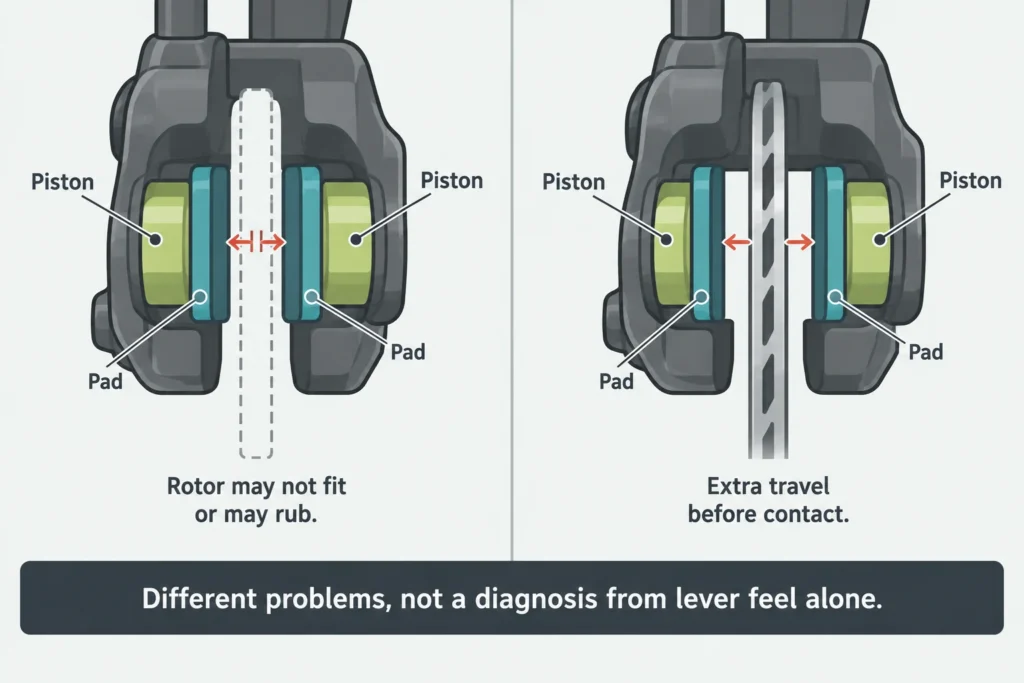
If the change followed transport, one detail is worth recording: was the lever squeezed while the wheel was out? Without the rotor or the appropriate pad spacer, the pistons behind the pads can move outward and narrow the gap, leaving the rotor difficult to reinstall or rubbing once it’s back. That’s a useful clue, but it doesn’t automatically explain a soft lever or mean there’s a leak.[2][3]
Pads sitting too far from the rotor create a different problem: extra lever travel before contact. SRAM’s troubleshooting guidance for eTap AXS brakes addresses insufficient piston advancement before recommending a bleed. I wouldn’t jump straight to bleeding yours, either. Pads too close together and pads too far apart aren’t the same fault, and that model’s remedy isn’t a universal procedure.[3][6]
Imagine I’m beside the car, front wheel reinstalled and work bag packed, when the lever comes back farther than I remember. The bike was supposed to make the job faster, and I’m tempted to turn an adjuster until it feels better. Instead, I document the brake setup and call for a pickup. The theory I like the most about a repair isn’t as helpful as the change.
Look outside the system; leave it closed
While the bike is still, check the lever for wetness and look along the hose and at the caliper and connections. Also, check for hose damage. Don’t touch the braking surfaces and note if the wheel is out of position or the rotor is not caught between the pads. Leave the lever alone and use the spacer specified by the manufacturer if the wheel is out of position.[1][2]
If you suspect the brake is leaking, you can’t rely on the fluid to evaporate. Fluid on the pads is considered a worn pad and needs to be replaced. Finding the fluid to be dry would be an improvement, but doesn’t rule out there not being fluid present internally. These checks provide the mechanic with clues, not proof the brake is ready to be used.[1][3]
I would hold off on the suggestion to “just top it up.” Don’t rely on a YouTube video for a brake fluid bleed and don’t open a reservoir and put fluid in it. The shortcut “SRAM uses DOT, Shimano uses mineral oil” isn’t enough to determine what to use in your brake.[3][4][5]
For example, the SRAM eTap AXS manual cited here says DOT 4 or DOT 5.1, not DOT 5 or mineral oil. The SRAM MTB manual says use Maxima Mineral Brake Oil, and doesn't allow DOT. Within Shimano’s oil systems, BL-M9200 uses Low Viscosity Oil, and BL-MT200 uses Hydraulic Mineral Oil. Shimano doesn’t allow mixing those oils. Not all brake fluids are created equal, and using the wrong fluid can cause component failure.[3][4][5]
The name of the fluid doesn't determine the tool or fluid selection, either. The SRAM DB8 Stealth brake uses the mineral oil bleed kit, not the SRAM DOT bleed kit. That’s why pictures of your levers and calipers are necessary to make the right choice of fluid, tools, and procedure.[5][7]
Give the shop facts, not a preordered bleed
- Which brake changed, plus photos of the lever and caliper model markings.
- What happened before? Did you recently remove the wheel? Pull the wheel-out lever? Adjust the orientation of the bike during transport? Crash? Get recent brake work?
What did you observe?
- What you observed: handlebar contact, weak braking, wetness, rubbing, or temporary improvement after squeezes.
- Is it wet? Is there rub? Is it improving, temporarily?
What have you adjusted or added? Give the fluid name if fluid was added.
Ask for the reason the sudden change was identified, and the brake’s function checked after the repair. You need this to transport the bike again.
Sources and references
- Shimano: Hydraulic Disc Brake (SHIMANO Low Viscosity Oil), UM-2RC0A-001 (2025-06)
- Shimano: Hydraulic Disc Brake User's Manual, UM-8VR0A-009 (2022-02)
- SRAM: eTap AXS HRD Caliper, Hose Replacement, and Lever Replacement Service Manual, Rev J (2022)
- SRAM: Mineral Oil MTB Disc Brake Installation, Hose Shortening, and Bleed Manual
- Shimano: Supported Models for Each Oil Type, DM-BROIL-02 (2025-06)
- SRAM: Troubleshooting eTap AXS Disc Brakes
- SRAM: Does SRAM DB8 Stealth feature Bleeding Edge?