
City riding is less about pedaling hard than about managing three repeating conflicts: cars crossing your line at intersections, hazards coming off the curb, and blind spots beside larger vehicles. The CDC says most bicyclist deaths occur in urban areas, and its bicycle safety page notes that roughly 29 percent occur at intersections while about 59 percent occur away from intersections. In other words, a safe city-bike routine has to work block by block, not just at stoplights. (cdc.gov)
NHTSA’s guidance for riders is straightforward: ride predictably, travel with traffic, minimize blind spots, and look over your shoulder before changing position or turning. The hard part is doing that calmly when a rideshare stops half in the bike lane or an SUV starts turning across you. The practical fix is to make a repeatable decision earlier, before the conflict reaches your front wheel. (nhtsa.gov)
Table of Contents
- Why these three hazards become money problems
- The CCB Reset: a three-zone scan for the next 100 feet
- Intersections: ride for visibility, not for technical priority
- Parked cars: paint does not cancel the door zone
- Blind spots: if the vehicle is bigger, your margin must get bigger
- Decision table: what to do before the situation becomes a near-miss
- A realistic cost example: safer habits beat fast habits
- Common mistakes that turn normal blocks into hazard zones
- When your first plan still feels unsafe
- How to verify this advice on your own route
- Bottom line
- References
TL;DR
- At intersections, protect your line early. A car that can turn across you is a live hazard even if it has not committed yet. (highways.fhwa.dot.gov)
- Next to parked cars, ride outside the door zone when space allows. FHWA research found riders needed about 30 inches from parked vehicles to be relatively safe from an opening door. (fhwa.dot.gov)
- Around trucks and buses, never linger on the right side near a turn. FMCSA says large vehicles have huge blind spots and need wide turns. (fmcsa.dot.gov)
- Use the CCB Reset in real time: Cross, Curb, Blind. If two zones light up at once, slow down and reset behind the hazard.
- If the same block keeps forcing hard braking or last-second swerves, treat it as a route problem and change something concrete.
Why these three hazards become money problems
A minor city-bike crash rarely stays minor on the budget side. The impact may be low-speed, but the aftermath stacks up fast: an urgent care copay, a bent rotor or wheel, a phone mount replacement, a rideshare home, and maybe lost work if the bike is down. NHTSA’s 2023 crash compilation recorded 1,166 pedalcyclist fatalities, and failure to yield right-of-way appears as a related factor in 31 percent of pedalcyclist fatalities. The point is not fear. It is that conflict management is cheaper than recovery. (crashstats.nhtsa.dot.gov)
Imagine a weekday commuter who clips a suddenly opened door at 12 mph. No ambulance, no hospital stay. Still, the costs can add up quickly: $85 for urgent care, $60 for a wheel true, $35 for bar tape and a bell, $42 in rideshares for two days, and $88 in missed hourly pay. That low-speed mistake is now a $310 week. Riding a little farther from parked cars might have felt slower, but it would likely have been cheaper.
The CCB Reset: a three-zone scan for the next 100 feet
Prior to any street location, including intersections, public transport or blocked lanes, reset your CCB to the start of every street location. You must first scan your next one hundred feet down the street for any “Cross”, “Curb”, or “Blind” moving targets. You will then adjust your travelling speed to allow for the actual number of moving targets (live conflicts) in your area; one (1) live conflict means you need to ‘Cover your Brakes & Make Space’ from it; two (2) live conflicts means you need to ‘Slow Down Enough to Stop Smoothly;’ and three (3) or more live conflicts means not to continue driving alongside of the live conflicts but rather to reset behind them.
- Cross: Can a driver cut across your path from a left turn, right turn, driveway, or stop sign? Front wheels and speed usually tell the truth faster than turn signals. Federal guidance identifies turning conflicts as common bicycle crash patterns at intersections. (highways.fhwa.dot.gov)
- Curb: Are parked cars occupied, recently parked, loading passengers, or showing reverse lights? FHWA guidance and research both flag dooring and parking-side conflicts as recurring problems next to curbside parking. (fhwa.dot.gov)
- Blind: Is there a truck, bus, tall SUV, or van beside you, slightly ahead of you, or backing near you? FMCSA warns that large vehicles have huge blind spots and need room for wide turns and long stopping distances. (fmcsa.dot.gov)
- Reset: If two zones overlap, do the boring thing. Drop a bike length, let the conflict develop in front of you, and ride through after it resolves.
This article is general safety information, not legal advice. Bike-lane rules, sidewalk-riding rules, and right-of-way details vary by state and city, and NHTSA specifically notes that sidewalk legality depends on local law. If you were injured or cited, consider getting local legal or insurance advice. (nhtsa.gov)
Intersections: ride for visibility, not for technical priority
Intersections create several repeat conflicts: a driver turning left across you, a driver turning right across you from the same direction, and complex left turns by the rider. FHWA’s signalized-intersection guide notes that a rider going straight faces the same conflicts as a driver plus additional conflicts from same-direction right turns. It also notes that left turns grow harder as intersections get larger. (highways.fhwa.dot.gov)
- Set your lane position early. If a car can squeeze past and then turn across you, move to a more visible position before the corner, using the bike lane or travel lane as local rules and road markings allow. Waiting until the last 20 feet invites a right-hook conflict. (nhtsa.gov)
- Treat the front wheel as the tell. A slight roll, steering angle, or creeping hood matters more than a late turn signal.
- On a fresh green or at an uncontrolled crossing, take a short half-beat scan instead of sprinting. NHTSA reminds drivers turning right on red to look right and behind, which is exactly why a cyclist should assume some will not. (nhtsa.gov)
- Do not overlap the rear quarter of a right-turning vehicle. Either get clearly ahead before the turn zone begins or, more often in city traffic, slot in behind and go straight after the turn is over. That is slower by seconds and often much safer. (highways.fhwa.dot.gov)
- For big, multi-lane left turns, use a two-stage left if needed. FHWA notes that many riders are more comfortable handling larger intersections in a more pedestrian-style sequence instead of weaving across lanes at the last moment. (highways.fhwa.dot.gov)
Parked cars: paint does not cancel the door zone
A painted bike lane next to parking can still put you in conflict with doors, backing cars, and rideshare pickups. FHWA research on shared lane markings found the door zone in its study extended about 9.5 feet from the curb, and riders needed about 30 inches from parked vehicles to be relatively safe from an opening door. Another FHWA guide notes that bike lanes next to on-street parking are problematic when there is not enough space to keep riders out of an opened door and recommends 13 feet of combined parking and bike-lane width. (fhwa.dot.gov)
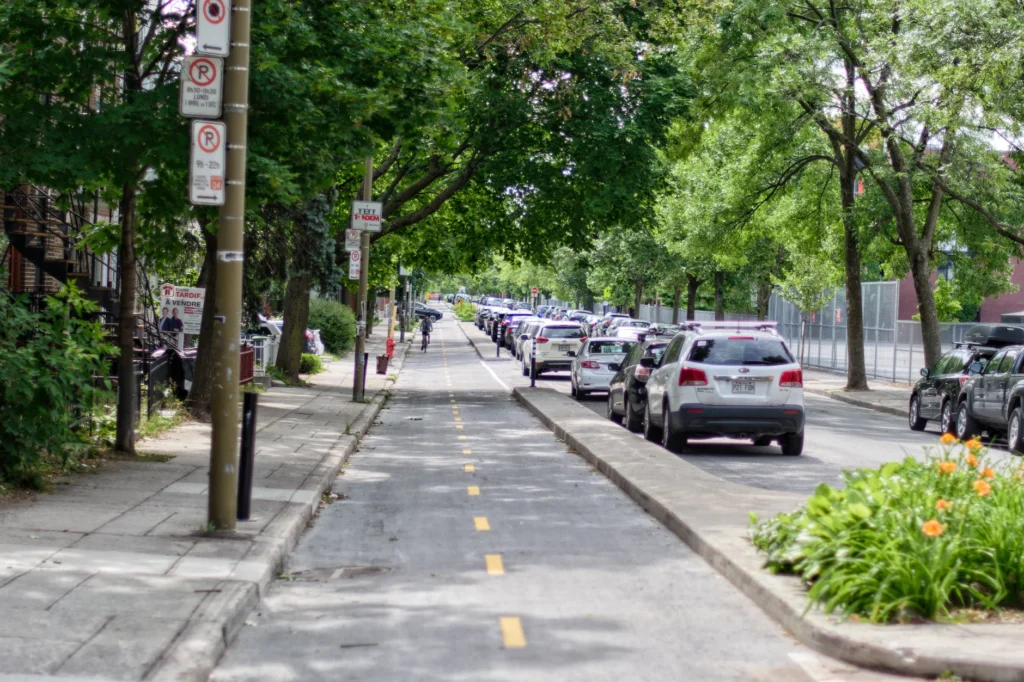
- Use about 3 feet from parked cars as a practical default when the street allows. If that makes drivers impatient, the lane is probably too narrow for a car and a bike to travel comfortably side by side. (fhwa.dot.gov)
- Read parked cars like active hazards, not furniture. Look for silhouettes in the driver seat, brake lights, reverse lights, a fresh rideshare stop, a wheel turned outward, or a trunk opening.
- If you must pass a line of occupied cars in tight space, cut speed first, not clearance. Slowing a few mph buys time to brake for a door without swerving into traffic.
- Be extra wary near diagonal parking and driveways. FHWA notes that diagonal parking creates conflicts because backing drivers have poor sight lines to approaching cyclists. (fhwa.dot.gov)
Blind spots: if the vehicle is bigger, your margin must get bigger
Blind-spot risk changes the moment a bus, box truck, or semitrailer enters the picture. FMCSA says large vehicles have huge blind spots, may be backing where they cannot see directly behind, need wide right turns, and may need up to two football fields to stop. The safe default is simple: do not sit beside them at the curb, and do not merge closely in front of them. (fmcsa.dot.gov)
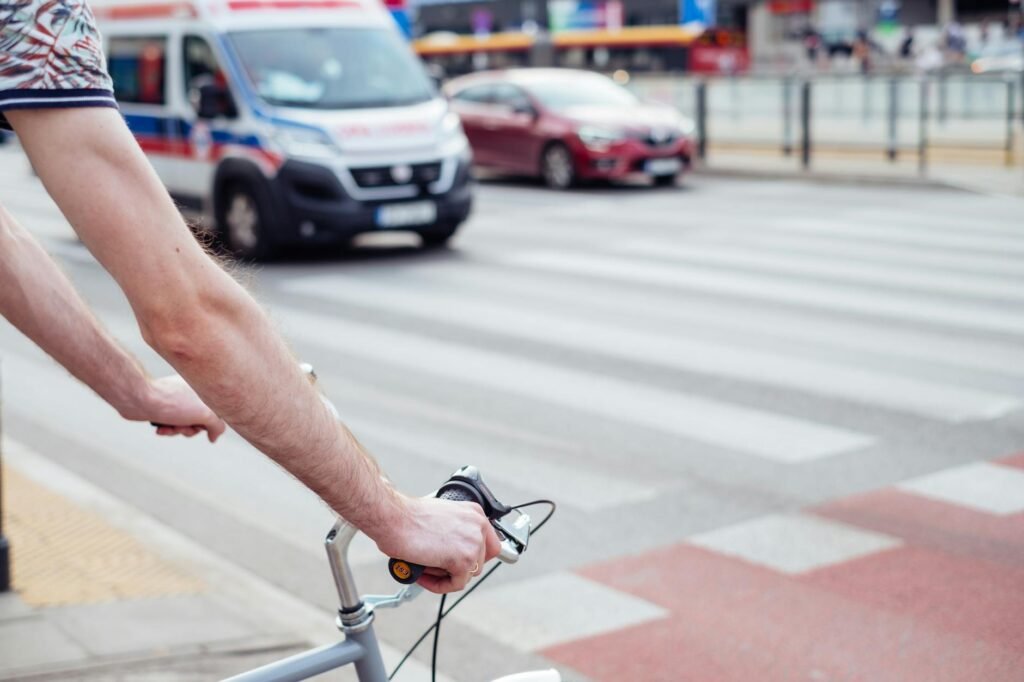
- Never pass a truck or bus on the right as it approaches or waits at an intersection. FMCSA explicitly advises riders to wait for the turn instead of positioning between the vehicle and the curb. (fmcsa.dot.gov)
- If you cannot see the driver’s face or mirror clearly, assume the driver has not truly located you. That is not a law. It is a good survival rule.
- Back off sooner than feels necessary. One bike length buys you sight lines, braking room, and an exit route.
- At night or in rain, use front and rear lights and assume your visibility estimate is too optimistic. FMCSA advises lights and reflectors in bad weather and at night. (fmcsa.dot.gov)
Decision table: what to do before the situation becomes a near-miss
| Situation | Best default move | What you are buying | Backup if the lane feels wrong |
|---|---|---|---|
| Car waiting to turn left across your path | Cover brakes, hold a visible line, and watch the front wheels, not just the signal. (highways.fhwa.dot.gov) | Time to react to a gap misjudgment | Reduce speed enough to stop before the crosswalk or lane line. |
| Car ahead may turn right across you | Either get clearly ahead early or slot behind. Do not hover at the rear quarter panel. (nhtsa.gov) | Less chance of a right hook | If unsure, reset behind the car and go straight after the turn. |
| Bike lane beside parked cars | Ride outside the door zone when room allows. (fhwa.dot.gov) | Door clearance and room to brake | Slow down and scan for occupants if clearance disappears. |
| Truck or bus on your left at a red light | Do not stay beside the right side of the vehicle. Drop behind or wait. (fmcsa.dot.gov) | Visibility and protection from a wide turn | Let the vehicle clear the intersection before you continue. |
| Delivery van blocking the bike lane | Merge early, not at the bumper. Signal, shoulder check, and take the safest visible line available. (nhtsa.gov) | A predictable move instead of a panic swerve | Stop behind the van until a clean merge opens. |
| Large multi-lane left turn | Use a two-stage left instead of forcing across lanes late. (highways.fhwa.dot.gov) | Lower stress and fewer weaving conflicts | Dismount and cross in stages where local rules allow. |
A realistic cost example: safer habits beat fast habits
For example, if an urban cyclist rides to & from work using a 4.5 mile trail, with 22 working days per month, there are 7 intersections and 4 parked-cars locations on the route to navigate through. After one bad experience with a door, the cyclist now stays outside of the door zone, will not accept passing cars that are turning right, and waits for buses and trucks to go ahead of them. Time will be added to his commute because of these changes, about 90 seconds each way; therefore, these changes will add a total of approximately 66 minutes per month to the cyclist’s overall travel time!
Now compare that with one avoidable low-speed crash: $75 urgent care copay, $110 for a wheel true and brake work, $54 in rideshares while the bike is in the shop, and one lost four-hour shift at $22 an hour, or $88. Total: $327. In personal finance terms, safer city riding is not just risk reduction. It is expense control.
Common mistakes that turn normal blocks into hazard zones
- Following the paint instead of the risk. A bike symbol beside parked cars is not permission to ignore doors. (fhwa.dot.gov)
- Trying to save a few seconds by passing on the inside of a turning car. The inside line is where many city-bike surprises happen. (highways.fhwa.dot.gov)
- Riding beside a truck or bus because the light is red and everything seems paused. Red lights change. Wide turns happen. Blind spots stay blind. (fmcsa.dot.gov)
- Treating parked cars as static. Doors open, reverse lights come on, passengers step out, and delivery drivers reenter traffic.
- Using the sidewalk as a fast bypass at driveways and corners. NHTSA warns that drivers often do not expect fast-moving bike traffic on sidewalks when backing or turning. (nhtsa.gov)
- Letting hurry set your line. Many bad curbside decisions start with being late or annoyed rather than with not knowing the rule.
When your first plan still feels unsafe
At times, it’s beneficial to acknowledge that a particular street is just too hard to ride. If conditions such as rain, night, glare, construction projects, or repeated blockages of the bike lane are pushing you into a door or blind spot; then instead of trying to be all tough and making a dangerous line, think about how to change the environment to make bikes safer.
- Move one block over to a calmer parallel street, even if it adds distance.
- Time-shift by 10 or 15 minutes to miss delivery rushes or school pickup traffic.
- Use a two-stage left, a mid-route dismount, or a short walk through the worst half block if that is the cleanest option.
- At night or in bad weather, run front and rear lights and lower speed more than feels necessary. FMCSA recommends lights and reflectors in low-visibility conditions. (fmcsa.dot.gov)
- If a route repeatedly makes sidewalk riding feel like the only survivable option, rethink the route. NHTSA says to avoid or minimize sidewalk riding, and if it is legal where you live, to slow down, look for turning traffic, and be prepared to stop at crossings. (nhtsa.gov)
How to verify this advice on your own route
- Ride the same route three times this week with the CCB Reset in mind.
- Make a simple note after each ride: where did you brake hard, swerve, or feel surprised?
- Tag each spot as Cross, Curb, or Blind. If the same block gets tagged twice in a week, change something concrete: route, lane position, time of day, or whether you use a two-stage left.
- Practice the harder moves away from heavy traffic. NHTSA recommends building skills in lower-stress places before handling traffic and points riders toward on-bike classes. (nhtsa.gov)
- Ask one question at the end of each ride: did I get surprised because I lacked skill, or because I stayed beside a conflict too long? Many improvements come from resolving the conflict earlier.
- Recheck your setup once a month: brake feel, bell, light battery, mirror if you use one, and whether your usual route has changed because of construction or curbside loading patterns.
A useful audit rule is two surprises per week on the same block. That is enough evidence to change the route, and not much reason to keep hoping it improves on its own.
Bottom line
The safest city riders are not necessarily the fastest or the boldest. They are the ones who spot the next conflict first and refuse to ride beside it. At intersections, win visibility. Near parked cars, buy door clearance. Near trucks and buses, buy separation. If you make those three habits automatic, your rides will usually feel calmer, and your costs may stay lower too. (nhtsa.gov)
Should I stay in a painted bike lane even if it hugs parked cars?
Not blindly. A painted lane can still put you in the door zone. When space allows, keep practical clearance from parked cars; if the layout still feels tight, slow down or use a safer visible line where local rules permit. (fhwa.dot.gov)
Is it safer to pass stopped traffic on the right?
Usually not near intersections, driveways, buses, or trucks. NHTSA highlights turning conflicts, and FMCSA warns against positioning yourself between a large vehicle and the curb near a turn. (nhtsa.gov)
How much space should I leave from parked cars?
A good working default is about 3 feet when the street gives it to you. FHWA door-zone research found riders needed about 30 inches from parked vehicles to be relatively safe from an opening door. (fhwa.dot.gov)
What should I do if a truck and I arrive at the light together?
Do not wait beside the truck’s right side. Drop behind it or hold back where the driver can clearly see you, and let the turn happen before you continue if there is any doubt. (fmcsa.dot.gov)
Are intersections really the main danger?
They are a major danger, but not the whole story. The CDC says about 29 percent of bicyclist deaths occur at intersections and about 59 percent occur away from intersections, which is why curbside parking and midblock visibility matter so much. (cdc.gov)
Is sidewalk riding safer in the city?
Not automatically. NHTSA says to avoid or minimize sidewalk riding because drivers often are not looking for moving bike traffic when turning or backing. If sidewalk riding is legal where you live and you use it briefly, slow down and treat every driveway and corner as an active conflict. (nhtsa.gov)
References
- NHTSA Bicycle Safety – https://www.nhtsa.gov/road-safety/bicycle-safety
- CDC Bicycle Safety – https://www.cdc.gov/pedestrian-bike-safety/about/bicycle-safety.html
- FMCSA Tips for Bicyclists and Pedestrians – https://www.fmcsa.dot.gov/ourroads/tips-bicyclists-and-pedestrians
- FHWA BIKESAFE Intersection Treatments – https://highways.dot.gov/safety/pedestrian-bicyclist/safety-tools/countermeasuresintersection-treatments-bicycle-safety
- FHWA Evaluation of Shared Lane Markings – https://www.fhwa.dot.gov/publications/research/safety/pedbike/10044/index.cfm
- FHWA University Course on Bicycle and Pedestrian Transportation, Chapter 15 – https://www.fhwa.dot.gov/publications/research/safety/pedbike/05085/chapt15.cfm
- NHTSA Traffic Safety Facts 2023 – https://crashstats.nhtsa.dot.gov/Api/Public/ViewPublication/813738