
Riding in urban areas becomes much easier if we start to think in terms of moderation instead of extremes . This guide discusses visibility; predictability and calmness while in traffic; a lane positioning scorecard; a decision table ; common mistakes made by riders and how to practice low-stress riding consistently.
TL;DR
- The best place for you to ride your bike in traffic typically falls somewhere between following your car and being on the sidewalk. You’re safest when you’re riding where other drivers expect you to ride. This is accomplished by following a straight path, with proper and early placement.
- Use the Seen-First Position Test: sight line, passing room, side hazards, next move, and escape space. If a street segment scores low, change position, slow down, or change the route.
- Confidence usually comes from earlier decisions, not braver ones: move left before the squeeze point, choose calmer streets, and set up for turns well before the intersection.
- Many common crashes start with predictable patterns: hugging the curb, weaving around parked cars, passing turning traffic on the right, or lingering beside trucks and buses.
- If a road is too fast, too narrow, too dark, or too chaotic, the confident move may be a different route, a two-stage turn, a short walk-through, or a transit connection.
Riders are faced with a dichotomy when it comes to dealing with traffic in urban areas – whether to act as a “miniaturized car” by taking every opening available in a lane of traffic or not to bother others by riding at the edge of the road or retreating onto the sidewalk. Unfortunately, neither of these strategies offers riders a safe way of traveling in traffic. Both NHTSA and the League of American Bicyclists recommend a third way to ride safely in traffic by maintaining predictability, riding in accordance with how automobile drivers are looking, and matching one’s position with the roadway a rider is traveling on; this is what true confidence when riding in traffic actually looks like.
The reason this is essential is that it has significant implications. According to the CDC, there are approximately 1,000 deaths every year due to collisions between bicycles and motor vehicles; as well, approximately 120,000 cyclists are treated at emergency rooms for non-fatal injuries caused by crashes. A fearlessness does not need to be obtained in order for you to reduce your risk; you only need a systematic approach to reading a road/street, making a selection regarding your path, and understanding when to reduce your speed.
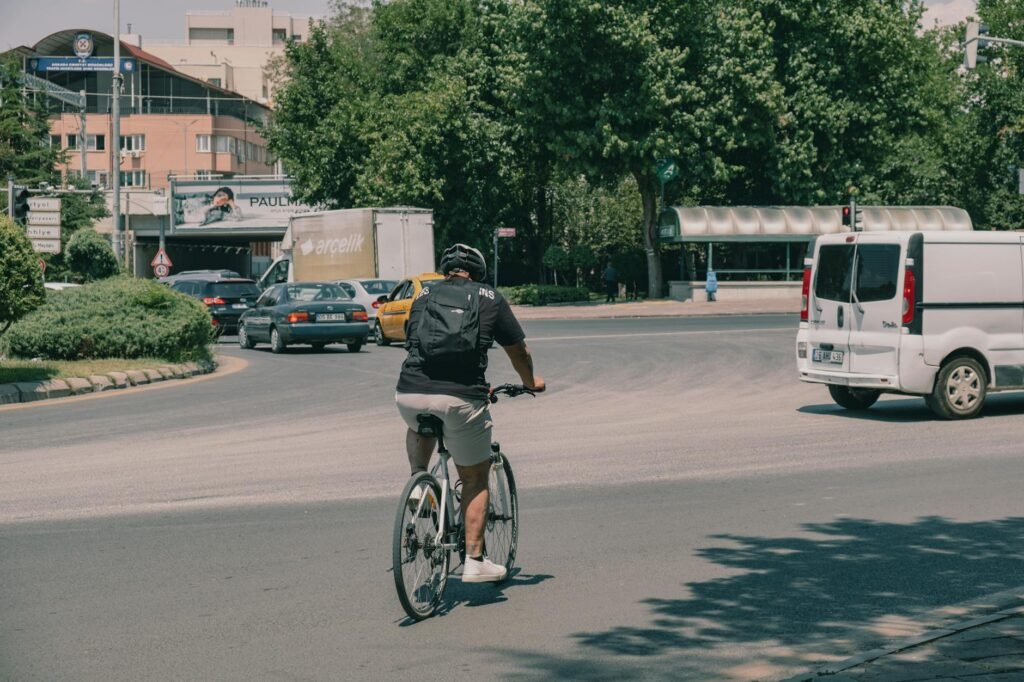
The real goal is to be legible
Riding safely in traffic is more about limiting surprises for other drivers than establishing assertive rights on the road. When you ride with consistent lane positioning, predictable line, and are clearly visible when making your next move, there will be fewer issues for motorists in assessing your intention and riding safely. In order to achieve these conditions, you must ride with traffic instead of against it, avoid making sudden movements to change lanes between parked vehicles, signal and check for other motorists throughout the change of position, and stay out of blind spots. When deciding where to ride, it is also important to recognize that the right edge of the road may not always be the safest zone. A gutter filled with glass, a row of parked cars, or an approaching right-hand turn lane could result in your riding next to the curb being the most hazardous location on the block.
Use the Seen-First Position Test
The below scorecard provides a guideline for assessing how confusing any block, bicycle lane, or intersection approach may be by awarding 1 point for each “true” item. A result of 4 or 5 indicates this segment is normal and manageable with typical levels of focus; a score of 3 means that something must change immediately (such as moving sooner, slowing down, or simplifying the turn). A score between 0 and 2 indicates that the street has too many variables requiring your attention and your backup plan should be implemented right away.
- Sight line: Am I riding where the next driver is likely to look for moving traffic, not tucked into a space they may dismiss as shoulder room?
- Passing lane: I have to ask myself: if someone tried to pass in front of me right now, is there enough width to do it without squashing me? If not, then I should be in control of the available space and keep from encouraging any chances of a bad pass.
- Side hazards: Am I clear of door zones, storm grates, debris, bus pull-ins, curb seams, and the last-second movements that come from parked cars?
- Next move: Does my current lane position match what I need to do in the next 5 to 10 seconds, especially near an intersection or merge?
- Escape space: If a driver misjudges the situation, do I have room to brake, hold my line, or move slightly without hitting a curb, door, or parked car?
The value of this test is in keeping you out of two classic traps: being too confident = taking the corridor that offers you no path and no way out; and being too timid = riding on the edge but the edge has many hazards and is hard for drivers to see when they turn. Riding Seen-First is calmer than either of these.
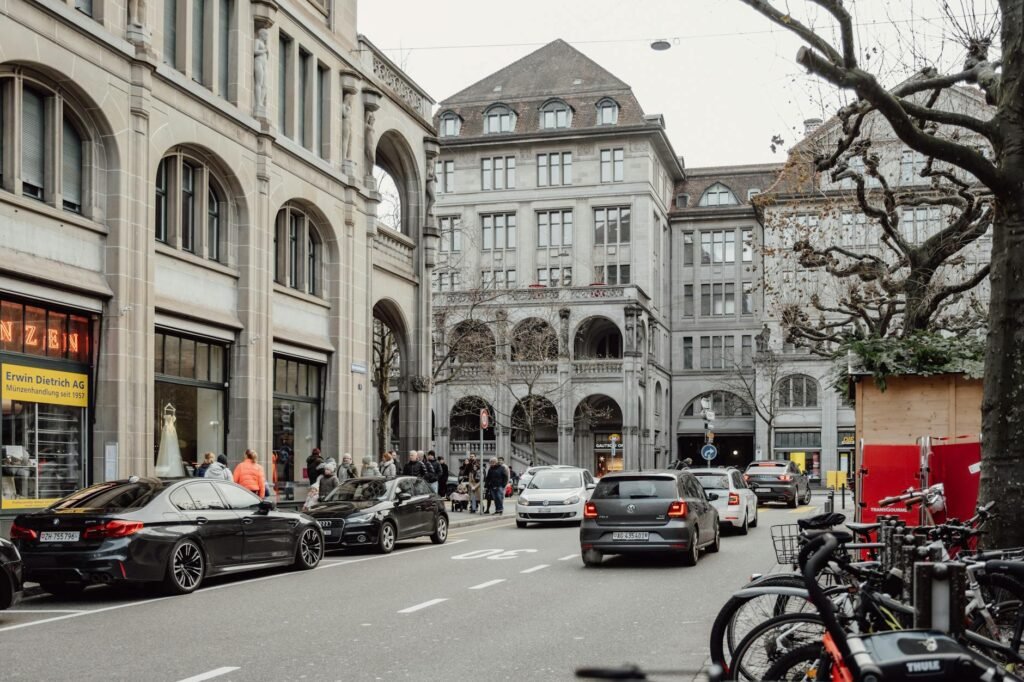
What lane position usually means on real streets
| Street situation | Best default move | Why it works | If it still feels too hot |
|---|---|---|---|
| Calm neighborhood street with no parking | Ride in the right third of the lane, not on the paint edge | You stay predictable and leave room for small hazards without drifting | Practice here first until shoulder checks and one-hand signaling feel steady |
| Narrow lane with no room for a car to pass safely within the lane | Move toward the center of the lane before the squeeze point | You prevent the dangerous half-pass that happens when riders invite a car into nonexistent space | Wait for a larger gap or use a calmer parallel street |
| Parked cars on your right | Ride outside the door zone in a straight line | This avoids dooring and prevents the weave-in, weave-out pattern drivers misread | Slow slightly and let following traffic pass at the next wider spot |
| Bike lane with debris, door risk, or a blocked section | Leave the bike lane early, signal, and take usable roadway space | A painted bike lane is not safer if it puts you in debris, doors, or conflict with turning cars | If legal and very short, a walk-through on the sidewalk can be better than forcing a bad merge |
| Approaching an intersection with right-turn traffic | Set up early so your position clearly matches your direction of travel | Late moves create right-hook conflicts and leave no time for drivers to process you | Tuck in behind the queue, go straight after it clears, or use a two-stage crossing |
| Left turn across multiple lanes on a busy arterial | Merge one lane at a time only if it is calm and visible; otherwise do a two-stage left turn | You keep the task within your current skill instead of forcing a stressful sweep across traffic | Dismount and use the crosswalk sequence if that is the safer choice that day |
The pattern is: Your safest path is typically determined before the point of conflict, not during it. Motorcyclists can be forced into tight spots because they don’t anticipate when to move left, when to exit a poor cyclist’s path, or how to position themselves for the direction in which they are travelling.
A realistic commute example with numbers
Take a 5.2 mile commute to/from work, with route A being a direct route of 4.4 miles and 19 minutes in the 35 mph commercial corridor of a major road with approximately 9 driveways, one bus pinch point, and 2 intersections where through traffic gets placed to the right of turning traffic. Route B is a longer route of 5.2 miles, and takes approximately 24 minutes, but is a combination of using a neighbourhood grid system, the shared bike boulevard and one segment of about a half mile of the collector. Route A will save you about 5 minutes of round trip time, but has 6 conflict points that score as 2 or 3 on the ‘Seen First’ test. Conversely, Route B will take you an additional 10 minutes of round trip time, but will score 4 or 5 for the majority of the conflict points. Therefore, for the majority of riders commuting on weekdays, Route B offers a much better value proposition. The additional time allows for much calmer decision-making, fewer emergency merges, less risk of arriving late, less risk of arriving to work stressed, or damaging your bike and missing work.
The part many riders overlook is that confidence is not determined by picking the shortest possible line between two points but by establishing a path that you can repeat regularly regardless of how much physical or mental fatigue you may be experiencing due to work or riding in poor weather conditions.
Build skill with a traffic confidence ladder
- Start on a low-stress loop at an easy hour. Practice riding a straight line, shoulder-checking without drifting, and signaling with one hand for short stretches.
- Add one controlled intersection. Approach it several times and rehearse setting up early for going straight, turning right, and doing a two-stage left turn.
- Introduce one short narrow-lane segment. The goal is not speed. The goal is learning how it feels to move left before the pinch point instead of after it.
- Practice leaving and re-entering a bike lane when it becomes blocked, cramped by parked cars, or risky near a turn lane. Make the move deliberate and early.
- Repeat the same route at a slightly busier time of day. Familiarity lowers panic, and repetition shows which choices still hold up when traffic volume increases.
- Only then add longer mixed-traffic sections. If one block repeatedly feels chaotic, break the route apart and solve that block instead of forcing the whole ride.
Instead of making one great attempt at each complex act, you’re much better off doing 3 separate repetitions of that act. For example, spend 20 continuous minutes practicing what we call “shoulder check” and/or early lane position on the same calm block. You are learning a cycle: look, signal, move, settle. This cycle has more value than the sheer nerve it takes..
When the confident move is to back off
Although rider proficiency plays an essential role, it is not the only factor that determines rider safety on the roadways. Both NHTSA and the U.S. Department of Transportation indicate that the selection of routes, driver speeds, and road infrastructure contribute significantly to rider safety. The design of a six-lane arterial with high-speed cars, multiple right turn lanes, and limited to no escape routes will likely make it less safe for most people to ride a bike regardless of their level of experience. There is no moral failure on the part of the rider, but rather, it constitutes a design problem with the street.
- Use a longer but slower route if the direct corridor repeatedly scores low on the Seen-First test.
- Shift departure time by 15 to 20 minutes if peak turning traffic is the main problem.
- Use a transit connection or a short walk-through for one ugly bridge, ramp, or construction zone instead of treating it as a test of courage.
- At big left turns, choose a two-stage turn or use crosswalks if merging across lanes would overload you that day.
- If it is dark or visibility is poor, use a white front light and red rear light, and rethink any route that already felt marginal in daylight.
- Do not ride tired, impaired, or mentally cooked after a long day and expect your traffic judgment to be sharp.
Common mistakes that make riders feel invisible or erratic
- Hugging the curb to be polite, even when the lane is too narrow to share safely.
- Weaving around parked cars instead of holding one consistent line outside the door zone.
- Passing stopped or slowing right-turn traffic on the right at an intersection approach.
- Waiting until the last second to leave a bike lane or move left for a turn.
- Riding beside a bus or truck where the driver may not see you. If you cannot see the mirrors, assume they cannot see you.
- Treating every painted bike lane as mandatory, even when debris, doors, or parked vehicles make it unusable.
- Using the sidewalk as a default high-speed route. NHTSA warns that drivers often do not expect fast-moving bicycle traffic there, especially at driveways and turns.
- Looking at a phone, riding with distracting audio, or sacrificing control to signal when a quick brake is the more urgent task.
A 60-second curbside reset before you roll
- Brake check: Squeeze both levers and make sure the bike stops firmly before traffic forces you to test them.
- Visibility check: If it is dawn, dusk, night, rain, or low light, confirm your front white light and rear red light are charged and on.
- First pinch point: Name the first place on your route where you may need to leave the edge, a bike lane, or a shoulder.
- Backup move: Decide now whether your backup will be a two-stage turn, a short sidewalk walk-through where legal, or a calmer parallel block.
- Attention check: Put the phone away, silence notifications, and commit to no distracted riding.
- Line check: In the first quiet block, practice one shoulder check and one deliberate hand signal before the ride gets busy.
How to verify and pressure-test your plan
Even though this advice sounds logical, do not assume it is based on the sample alone. You should verify this advice based on your own experiences with other routes. Ride a new route first at a time of low stress. After riding that route, write down three areas of the route where you felt rushed, squeezed or invisible while you were riding. Then use the Seen-First test to rate those areas on a scale from 0 to 3. If both of your scores were 3 or less for the same area of the route and you continue to ride that route, change either the route, the time you ride it or how you handle yourself on that route. Check local regulations about riding on sidewalks, using signals and positioning yourself in traffic with local police or state agencies. If you would like feedback from outside sources, the League of American Bicyclists has several levels of instructors available to provide resources to help you assess how to transfer your habits into real life situations.
A final audit point: if you only feel comfortable when traffic is unusually polite, the route is probably too dependent on luck. A good traffic plan still works when drivers are ordinary, not ideal.
Bottom line
Being visible and moving quickly on a bicycle in traffic is the most important way to ride confidently. You are not a car and do not need to disappear into the pedestrian realm. You need to look at the street and take what you need to ride safely, using less than you should when the street requires more than it should. Those who ride with confidence are not necessarily the most visually daring; they are simply the most consistent and confident in their actions.
Is it safer to ride on the sidewalk when traffic feels fast?
Sidewalk biking Used to be but is not typically a strategy of choice. Riding on sidewalks creates a conflict for the bicycle rider and drivers at sidewalks when bicycle riders are travelling fast and the bicycle rider is not expected to be there. Sidewalk regulations vary by jurisdiction. If you are riding on a sidewalk for an extremely short distance (where allowed) go very slowly and treat it as though you are an invited guest of pedestrians and crossings.
When should I ride in the middle of the lane?
A narrow lane can be defined as an area that does not offer enough space for a passing vehicle; therefore, it must be taken into consideration when defining what constitutes being “too narrow.” Other conditions (such as obstacles) may also contribute to this definition. Ultimately, the purpose of these definitions is not to create a situation where one mode of transportation has the right-of-way over another; rather, the purpose is to keep everyone from feeling unsafe due to being “squeezed” together.
What if I need a left turn across heavy traffic and I am not comfortable merging?
A two-stage left turn or dismount and then using crosswalks may be less stressful than trying a complex merge before your fully prepared. A safe left turn is a proper left turn.
Do I have to stay in a bike lane if one exists?
This isn’t always the case. Depending on your state’s laws, an area designated for use as a bike lane does not guarantee safety due to the congested nature of the area, obstructing vehicles, improper markings, or being in a right-hand turn lane where there is traffic turning right. Check with your local government for their rules, then take into consideration the visible separation between the vehicles you will likely encounter using the lane.
How can I practice shoulder checks without drifting into traffic?
Find a location with a calm street or an open field. Follow through with your bike straight down the painted line until you have to look back (look over your shoulder for just a moment) and then look ahead again. It is very important to maintain light pressure on your handlebars and keep your TORSO relaxed during these drills. You will learn more quickly through repeated, shorter time drills than by forcing yourself to make longer looks while riding within “live” traffic.
References
- NHTSA: Bicycle Safety
- CDC: Bicycle Safety
- NHTSA: Cycling Skills Clinic Guide
- US Department of Transportation: Improving Safety for Walking, Biking, and Rolling
- League of American Bicyclists: Traffic Laws
- League of American Bicyclists: Ride Better Tips
- League of American Bicyclists: Rules of the Road
- League of American Bicyclists: State Bike Laws